Advertisements
Advertisements
Question
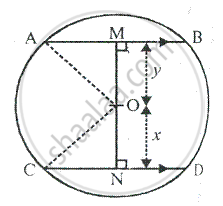
In the figure, given below, AB and CD are two parallel chords and O is the centre. If the radius of the circle is 15 cm, find the distance MN between the two chords of lengths 24 cm and 18 cm respectively.

Advertisements
Solution

Given, AB = 24 cm, CD = 18 cm
⇒ AM = 12 cm, CN = 9 cm
Also, OA = OC = 15 cm
Let MO = y cm and ON = x cm
In right angled ∆AMO
(OA)2 = (AM)2 + (OM)2
⇒ 152 = 122 + y2
⇒ y2 = 152 – 122
⇒ y2 = 225 – 144
⇒ y2 = 81
⇒ y = 9 cm
In right angled ΔCON
(OC)2 = (ON)2 + (CN)2
⇒ 152 = x2 + 92
⇒ x2 = 152 – 92
⇒ x2 = 225 – 81
⇒ x2 = 144
⇒ y = 12 cm
Now, MN = MO + ON
= y + x
= 9 cm + 12 cm
= 21 cm
APPEARS IN
RELATED QUESTIONS
In the figure, m∠DBC = 58°. BD is the diameter of the circle. Calculate:
1) m∠BDC
2) m∠BEC
3) m∠BAC

Calculate the area of the shaded region, if the diameter of the semicircle is equal to 14 cm. Take `pi = 22/7`

Prove that the parallelogram, inscribed in a circle, is a rectangle.
Prove that the rhombus, inscribed in a circle, is a square.
In the given figure, AB is a diameter of the circle with centre O. DO is parallel to CB and ∠DCB = 120°.
Calculate:
- ∠DAB,
- ∠DBA,
- ∠DBC,
- ∠ADC.
Also, show that the ΔAOD is an equilateral triangle.

In the given figure, AB is a diameter of the circle with centre O. DO is parallel to CB and ∠DCB = 120°.
Calculate : ∠DBA
Also, show that the ΔAOD is an equilateral triangle.

In the given figure, AB is a diameter of the circle with centre O. DO is parallel to CB and ∠DCB = 120°.
Calculate : ∠DBC
Also, show that the ΔAOD is an equilateral triangle.

In the given figure, BAD = 65°, ABD = 70°, BDC = 45°.
(i) Prove that AC is a diameter of the circle.
(ii) Find ACB.

In the given figure, AC is the diameter of the circle with center O.
CD is parallel to BE.
∠AOB = 80° and ∠ACE = 20°
Calculate:
- ∠BEC
- ∠BCD
- ∠CED