Advertisements
Advertisements
Question
In the course of your observations, did you notice any signs of the presence of living things, though the living things themselves were not seen? For example, did you notice any partly eaten fruits or shells, fallen feathers, animal tracks, dung, droppings, nests, cocoons, eggs, honeycombs, etc.?
Advertisements
Solution
Different types of living things are seen in different places. Some signs of their presence are seen sometimes, even if these living things are not seen themselves. For example, partly eaten fruits. shells, fallen feathers, animal tracks, dung, droppings, nests, cocoons, eggs, honeycombs, etc. are noticed during observations. Partly eaten fruits can confirm that there were squirrels, monkeys, or some fruit-eating birds before we arrived. From the fallen feathers, one could guess about the types of birds that visited the place. We can also guess from the animal tracks, pugmarks, dung, or droppings.
APPEARS IN
RELATED QUESTIONS
You being an environmentalist are interested in contributing towards the conservation of natural resources. List four activities that you can do on your own.
Which one term in the following includes the others?
air, flora, fauna, environment, water, sunlight, soil
Name the organisms whose uncontrolled activities are damaging the environment.
Could you observe any microorganisms?
Classify the following as natural or man-made.
stone.
Classify the following as natural or man-made.
dolphin
Classify the following as natural or man-made.
trees
Classify the following as natural or man-made.
pen
Classify the following as natural or man-made.
table.
Classify the following as natural or man-made.
brick
_______ is the process of converting waste materials into new materials.
Take a square paper. Fold its diagonals. Draw three lines in three triangles as shown in the picture.
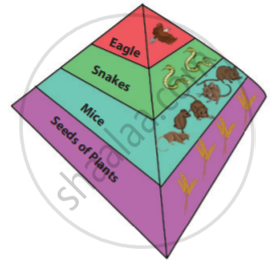
Cut from the edge of the diagonal to the center as shown in the picture.
If you fold this triangle and paste it behind the third triangle you get a pyramidal shape.
In one of the triangles, draw images of each of the organisms in the different levels.
In another triangle write the names of the organisms. In the last triangle, write the energy level of the organism. Have a look at the following example. You must come up with different organisms!.
When is the world environment day celebrated?
Excessive exposure of humans to UV-rays results in
- damage to immune system
- damage to lungs
- skin cancer
- peptic ulcers
