Advertisements
Advertisements
प्रश्न
In the course of your observations, did you notice any signs of the presence of living things, though the living things themselves were not seen? For example, did you notice any partly eaten fruits or shells, fallen feathers, animal tracks, dung, droppings, nests, cocoons, eggs, honeycombs, etc.?
Advertisements
उत्तर
Different types of living things are seen in different places. Some signs of their presence are seen sometimes, even if these living things are not seen themselves. For example, partly eaten fruits. shells, fallen feathers, animal tracks, dung, droppings, nests, cocoons, eggs, honeycombs, etc. are noticed during observations. Partly eaten fruits can confirm that there were squirrels, monkeys, or some fruit-eating birds before we arrived. From the fallen feathers, one could guess about the types of birds that visited the place. We can also guess from the animal tracks, pugmarks, dung, or droppings.
संबंधित प्रश्न
You being an environmentalist are interested in contributing towards the conservation of natural resources. List four activities that you can do on your own.
Fill in the following blank with suitable word :
The science that deals with the inter-relationships of living things with one another and their environment is called...........
The use of one of the following will pollute the environment. This one is :
(a) paper carry bags
(b) cotton cloth carry bags
(c) nylon cloth carry bags
(d) jute carry bags
What makes the earth’s atmosphere a heterogeneous mixture?
The compound obtained on reaction of iron with steam is/are:
What’s the solution?
We have to remove insects from the grain without using insecticides.
Micro-organisms form a part of the environment.
What are the different purposes for which fuels such as petrol, diesel, kerosene, natural gas, coal, and wood are used?
Give reason.
It is important to conserve the living components of the environment.
Classify the following as natural or man-made.
stone.
Classify the following as natural or man-made.
sunlight
Classify the following as natural or man-made.
trees
Classify the following as natural or man-made.
brick
Take a square paper. Fold its diagonals. Draw three lines in three triangles as shown in the picture.
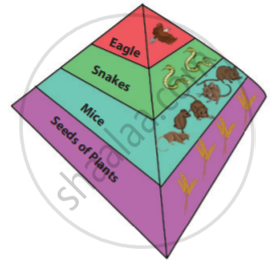
Cut from the edge of the diagonal to the center as shown in the picture.
If you fold this triangle and paste it behind the third triangle you get a pyramidal shape.
In one of the triangles, draw images of each of the organisms in the different levels.
In another triangle write the names of the organisms. In the last triangle, write the energy level of the organism. Have a look at the following example. You must come up with different organisms!.
These are abiotic factors.
- Sunlight
- Bacteria
- Air
- Plants
Suggest one word for the following statement/definition.
The physical and biological world where we live in
Select the mis-matched pair in the following and correct it.
Explain some harmful effects of agricultural practices on the environment.
