Advertisements
Advertisements
Question
In the given figure, if ABC is an equilateral triangle. Find ∠BDC and ∠BEC.

Advertisements
Solution
It is given that, ABC is an equilateral triangle
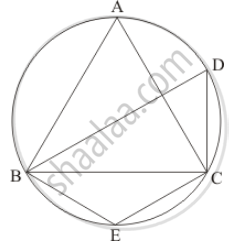
We have to find `angleBDC` and `angleBEC`
Since ΔABC is an equilateral triangle
So, `angleA = angleB = angleC = 60°`
And ABEC is cyclic quadrilateral
So `angle A + angle E = 180°` (Sum of opposite pair of angles of a cyclic quadrilateral is 180°.)
Then,
`angle E = 180° - 60°`
= 120°
Similarly BECD is also cyclic quadrilateral
So,
`angle E + angle D = 180°`
`angleD = 180° - 120°`
= 60°
Hence, `angle BDC `= 60° and `angle BEC = 120°`.
APPEARS IN
RELATED QUESTIONS
A point P is 13 cm from the centre of the circle. The length of the tangent drawn from P to the circle is 12cm. Find the radius of the circle.
Prove that the tangents at the extremities of any chord make equal angles with the chord.
O is the center of a circle of radius 8cm. The tangent at a point A on the circle cuts a line through O at B such that AB = 15 cm. Find OB
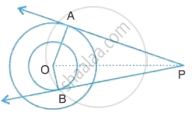
In figure, there are two concentric circles with centre O of radii 5 cm and 3 cm. From an external point P, tangents PA and PB are drawn to these circles. If AP = 12 cm, find the length of BP.
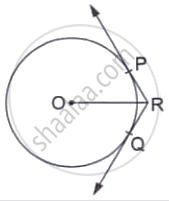
In the given figure, two tangents RQ and RP are drawn from an external point R to the circle with centre O. If ∠PRQ = 120°, then prove that OR = PR + RQ.
In Fig., chords AB and CD of the circle intersect at O. AO = 5 cm, BO = 3 cm and CO = 2.5 cm. Determine the length of DO.

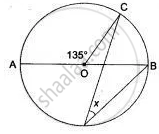
If O is the centre of the circle, find the value of x in each of the following figures
Draw a circle of radius of 4.2 cm. Mark its center as O. Takes a point A on the circumference of the circle. Join AO and extend it till it meets point B on the circumference of the circle,
(i) Measure the length of AB.
(ii) Assign a special name to AB.
If the angle between two radii of a circle is 130°, then the angle between the tangents at the ends of the radii is ______
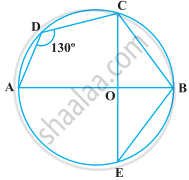
In the following figure, ∠ADC = 130° and chord BC = chord BE. Find ∠CBE.