Advertisements
Advertisements
प्रश्न
In the given figure, if ABC is an equilateral triangle. Find ∠BDC and ∠BEC.

Advertisements
उत्तर
It is given that, ABC is an equilateral triangle
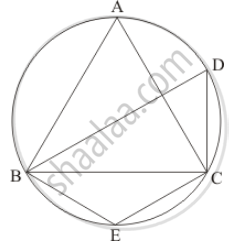
We have to find `angleBDC` and `angleBEC`
Since ΔABC is an equilateral triangle
So, `angleA = angleB = angleC = 60°`
And ABEC is cyclic quadrilateral
So `angle A + angle E = 180°` (Sum of opposite pair of angles of a cyclic quadrilateral is 180°.)
Then,
`angle E = 180° - 60°`
= 120°
Similarly BECD is also cyclic quadrilateral
So,
`angle E + angle D = 180°`
`angleD = 180° - 120°`
= 60°
Hence, `angle BDC `= 60° and `angle BEC = 120°`.
APPEARS IN
संबंधित प्रश्न
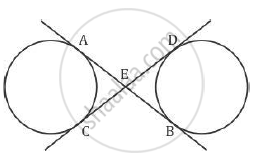
In Figure 1, common tangents AB and CD to the two circles with centres 01and 02 intersect at E. Prove that AB = CD.
If from any point on the common chord of two intersecting circles, tangents be drawn to circles, prove that they are equal.
Prove that the intercept of a tangent between two parallel tangents to a circle subtends a right angle at center.
In two concentric circles, a chord of length 8 cm of the large circle touches the smaller circle. If the radius of the larger circle is 5 cm, then find the radius of the smaller circle.
In the given figure, if chords AB and CD of the circle intersect each other at right angles, then x + y =
Radius of a circle with centre O is 4 cm. If l(OP) = 4.2 cm, say where point P will lie.
AD is a diameter of a circle and AB is a chord If AD = 30 cm and AB = 24 cm then the distance of AB from the centre of the circle is
Twice the radius is ________________
The tangent to the circumcircle of an isosceles triangle ABC at A, in which AB = AC, is parallel to BC.
In figure, tangents PQ and PR are drawn to a circle such that ∠RPQ = 30°. A chord RS is drawn parallel to the tangent PQ. Find the ∠RQS.
[Hint: Draw a line through Q and perpendicular to QP.]
