Advertisements
Advertisements
Question
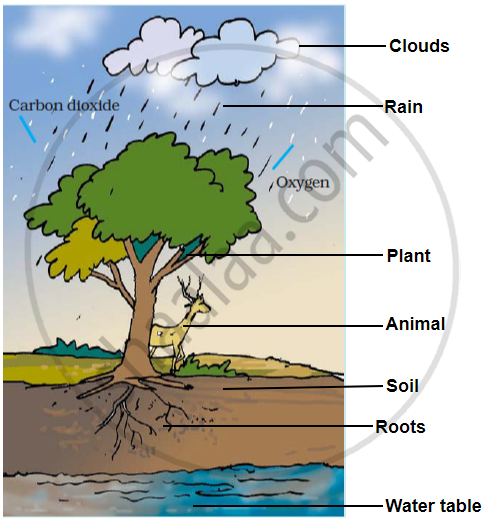
In the figure, the artist has forgotten to put the labels and directions on the arrows. Mark the directions on the arrows and label the diagram using the following labels:
clouds, rain, atmosphere, carbon dioxide, oxygen, plants, animals, soil, roots, water table.

Advertisements
Solution
APPEARS IN
RELATED QUESTIONS
Explain the role of forest in maintaining the balance between oxygen and carbon dioxide in the atmosphere.
Explain why there is no waste in a forest.
Why should we worry about the conditions and issues related to forests far from us?
Which of the following is not a forest product?
Which of the following statements is not correct?
Which of the following is not a use of forest?
Given below are a few statements related to biodiversity. Pick those that correctly describes the concept of biodiversity.
i. Biodiversity refers to the different species of flora and fauna present in an area
ii. Biodiversity refers to only the flora of a given area
iii. Biodiversity is greater in a forest
iv. Biodiversity refers to the total number of individuals of a particular species living in an area
Choose the correct option from the following.
Name any four useful products other than wood, which we get from forests.
Figure shows a part of a forest.

Write any three activities going on in the forest on the basis of this figure.
Visit a forest. Here is a list of points that would make your visit more fruitful.
- Make sure that you have permission to go into the forest.
- Make sure that you can find your way around. Get a map and go along with someone who is familiar with the area.
- Keep a record of the things you see and do. Observations make the visit interesting. Sketches and photographs are useful.
- You may record bird calls.
- Collect different kinds of seeds or hard fruits like nuts.
- Try to recognise various types of trees, shrubs, herbs, etc. Make lists of plants from different places in the forest and of different layers. You may not be able to name all the plants, but it is worth recording and seeing where they grow. Make a record of approximate heights of plants, crown shape, bark texture, leaf size, and flower colour.
- Learn to recognise the animal’s droppings.
- Interview the forest officials and the people of surrounding villages and other visitors.
You must never collect birds’ eggs, and their nests should never be disturbed.
You can read more on the following website:
