Advertisements
Advertisements
Question
State whether the following statement is true or false. If false, give the correct statement.
The forest keeps on growing and changing and can regenerate
Options
True
False
Advertisements
Solution
This statement is True.
Explanation:
Forests are dynamic ecosystems that are continuously growing, changing and regenerating. They undergo natural processes of growth, succession and regeneration over time. Trees and plants die and are replaced by new ones, allowing the forest to regenerate itself. Forests can recover from disturbances such as fires, storms or logging, as long as the ecosystem remains intact and the necessary conditions for regeneration are met.
APPEARS IN
RELATED QUESTIONS
Why should we worry about the conditions and issues related to forests far from us?
Global warming will cause
Enumerate the importance of forest.
Which of the following is the ‘biodiversity hot spots'?
When we destroy a forest, we destroy ______
Which of the following is not a use of forest?
Given below are a few statements related to biodiversity. Pick those that correctly describes the concept of biodiversity.
i. Biodiversity refers to the different species of flora and fauna present in an area
ii. Biodiversity refers to only the flora of a given area
iii. Biodiversity is greater in a forest
iv. Biodiversity refers to the total number of individuals of a particular species living in an area
Choose the correct option from the following.
The branchy part of a tree above the stem is known as
State whether the following statement is true or false. If false, give the correct statement.
Forests influence climate, water cycle and air quality
Figure shows a part of a forest.
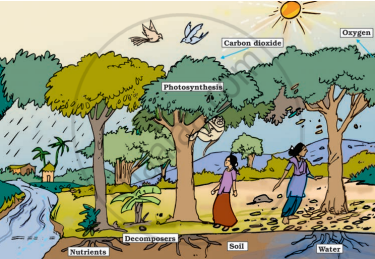
Write any three activities going on in the forest on the basis of this figure.
