Advertisements
Advertisements
Question
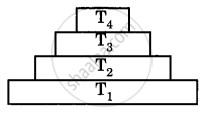
In the figure given alongside, the various trophic levels are shown in the form of a pyramid. At which trophic level the maximum energy is available?
Options
T4
T2
T1
T3
Advertisements
Solution
T1
Explanation:
At T1, producers, which make food, are present, and hence they are at the bottom of the trophic levels. As they get energy directly from the sun, they have the maximum energy. This energy keeps on reducing as it is passed on to the next trophic levels.
APPEARS IN
RELATED QUESTIONS
What will be the amount of energy available to the organisms of the 2nd trophic level of a food chain if the energy available at the first trophic level is 10,000 joules?
Define decomposers.
What is meant by a primary consumer?
What is a food chain?
The decomposers in an ecosystem ______.
The sea water contains water beetles, tadpole, fish and weeds.
Which organisms can trap solar energy to make food?
The following is a food chain that ends with human :
How does this food chain differ form a usual food chain involving human such as : plants → goat → human?
(a) Match the terms given in column I with the terms given in column II and column III having the same meaning:
| Column I | Column II | Column III | |
| (i) | Secondary consumer | Herbivore | 1st trophic level |
| (ii) | Primary consume | Autotroph | 3rd trophic level |
| (iii) | Producer | Carnivore | 4th trophic level |
| (iv) | Tertiary consumer | Large carnivore | 2nd trophic level |
(b) Give one example of a food chain having four organisms. Below each organism write the three appropriate terms from the part (a) above which you think it represents.
Name the process in which a harmful chemical enters the food chain and gets concentrated at each trophic level.
What does garbage consist of?
The harmful chemical which is accumulating in human beings through food chain is :
(a) benzenehexachloride
(b) dichlorodiphenyltrichloroethane
(c) chlorofluorocarbon
(d) abscisic acid
A food chain consists of fish, larvae, phytoplanktons and birds. The level of pesticides in water in which the fish, larvae and phytoplanktons live is quite high.
Which organism will have the maximum amount of pesticides accumulated through the food chain? What is this process known as?
| Human body is made up of five important components, of which water is the main component. Food, as well as potable water, are essential for every human being. The food is obtained from plants through agriculture. Pesticides are being used extensively for a high yield in the fields. These pesticides are absorbed by the plants from the soil along with water and minerals and from the water bodies these pesticides are taken up by the aquatic animals and plants. As these chemicals are not biodegradables, they get accumulated progressively at each trophic level. The maximum concentration of these chemicals gets accumulated in our bodies and greatly affects the health of our mind and body. |
- Why is the maximum concentration of pesticides found in human beings? (1)
- Give one method which could be applied to reduce our intake of pesticides through food to some extent. (1)
- Various steps in a food chain represent: (1)
- Food web
- Trophic level
- Ecosystem
- Biomagnification
- With regard to various food chains operating in an ecosystem, man is a: (1)
- Consumer
- Producer
- Producer and consumer
- Producer and decomposer
Give some examples for Biodegradable and Non-biodegradable waste.
| S. No. | Biodegradable waste | Non-biodegradable waste |
| 1. | Food Waste | Plastic Bottles |
| 2. | ||
| 3. | ||
| 4. | ||
| 5. |
The process of accumulation of harmful chemical substances like pesticides, in the body of living organisms at each trophic level of a food chain is known as ______.
Which of the following is an autotroph?
Food chains are very important for the survival of most species.

If 10,000 J solar energy falls on green plants in a terrestrial ecosystem, what percentage of solar energy will be converted into food energy?
Food chains are very important for the survival of most species.
Matter and energy are two fundamental inputs of an ecosystem. Movement of:
In the given food chain, suppose the amount of energy at the fourth trophic level is 5 kJ, what will be the energy available at the producer level?
Grass → Grasshopper → Frog → Snake → Hawk
