Advertisements
Advertisements
Question
In ΔABC is a right triangle such that ∠C = 90° ∠A = 45°, BC = 7 units find ∠B, AB and AC
Advertisements
Solution
Sum of angles in Δle = 180°
∠A + ∠B + ∠C = 180°
45° + ∠B + 90° = 180°
∠B = 180° − 135°
∠B = 45°
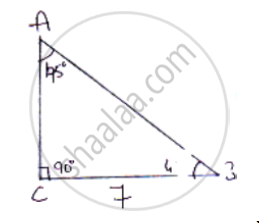
From figure `cos B = (BC)/(AB)`
`cos 45^2 = 7/(AB)`
`1/sqrt2 . 7/(AB)`
`AB = 7sqrt2 units`
From figure `sin B = (AC)/(AB)`
`sin 45^@ = (AB)/(7sqrt2)`
`1/sqrt2 = (AC)/(7sqrt2)`
∴ AC = 7 units
APPEARS IN
RELATED QUESTIONS
If ∠A and ∠B are acute angles such that cos A = cos B, then show that ∠A = ∠B.
State whether the following are true or false. Justify your answer.
sin θ = `4/3`, for some angle θ.
In the following, one of the six trigonometric ratios is given. Find the values of the other trigonometric ratios.
`cot theta = 12/5`
If 3 tan θ = 4, find the value of `(4cos theta - sin theta)/(2cos theta + sin theta)`
If `cos θ = 12/13`, show that `sin θ (1 - tan θ) = 35/156`.
If sin θ = `12/13`, Find `(sin^2 θ - cos^2 θ)/(2sin θ cos θ) × 1/(tan^2 θ)`.
if `cos theta = 3/5`, find the value of `(sin theta - 1/(tan theta))/(2 tan theta)`
if `cot theta = 3/4` prove that `sqrt((sec theta - cosec theta)/(sec theta +cosec theta)) = 1/sqrt7`
If `sin theta = a/b` find sec θ + tan θ in terms of a and b.
If Cosec A = 2 find `1/(tan A) + (sin A)/(1 + cos A)`
Evaluate the Following:
`(tan^2 60^@ + 4 cos^2 45^@ + 3 sec^2 30^@ + 5 cos^2 90)/(cosec 30^@ + sec 60^@ - cot^2 30^@)`
Evaluate the Following:
`tan 45^@/(cosec 30^@) + sec 60^@/cot 45^@ - (5 sin 90^@)/(2 cos 0^@)`
Find the value of x in the following :
cos 2x = cos 60° cos 30° + sin 60° sin 30°
If sin (A − B) = sin A cos B − cos A sin B and cos (A − B) = cos A cos B + sin A sin B, find the values of sin 15° and cos 15°.
The value of sin² 30° – cos² 30° is ______.
If sin A = `1/2`, then the value of cot A is ______.
What will be the value of sin 45° + `1/sqrt(2)`?
In the given figure, if sin θ = `7/13`, which angle will be θ?

`sqrt(3)` cos2A + `sqrt(3)` sin2A is equal to ______.
Let tan9° = `(1 - sqrt((sqrt(5)k)/m))k` where k = `sqrt(5) + 1` then m is equal to ______.
