Advertisements
Advertisements
Question
In a two dimensional motion, instantaneous speed v0 is a positive constant. Then which of the following are necessarily true?
Options
The average velocity is not zero at any time.
Average acceleration must always vanish.
Displacements in equal time intervals are equal.
Equal path lengths are traversed in equal intervals.
Advertisements
Solution
Equal path lengths are traversed in equal intervals.
Explanation:
Speed (Instantaneous Speed): The magnitude of the velocity at any instant of time is known as instantaneous speed or simply speed at that instant of time. It is denoted by v.
Quantitatively: Speed = Distance/Time
Mathematically, it is the time rate at which distance is being travelled by the particle.
- Speed is a scalar quantity. It can never be negative (as shown by the speedometer of our vehicle).
- Instantaneous speed is the speed of a particle at a particular instant of time.
Hence, Total distance travelled = Path length = (Speed) × Time taken
Important point: We should be very careful with the fact that speed is related to the total distance covered not displacement.
APPEARS IN
RELATED QUESTIONS
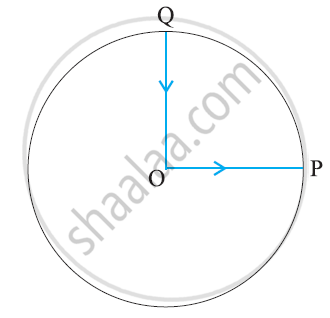
A cyclist starts from the centre O of a circular park of radius 1 km, reaches the edge P of the park, then cycles along the circumference, and returns to the centre along QO as shown in figure. If the round trip takes 10 min, what is the (a) net displacement, (b) average velocity, and (c) average speed of the cyclist?
In a harbour, wind is blowing at the speed of 72 km/h and the flag on the mast of a boat anchored in the harbour flutters along the N-E direction. If the boat starts moving at a speed of 51 km/h to the north, what is the direction of the flag on the mast of the boat?
For any arbitrary motion in space, state whether the following statement is true:
`"a"_"average"=["v"("t"_2) - "v"("t"_1)]/("t"_2 - "t"_1)`
(The ‘average’ stands for average of the quantity over the time interval t1 to t2)
For any arbitrary motion in space, state whether the following statement is true:
`"V"_"average"` = `(1/2)("v"("t"_1) + "v"("t"_2))`
(The ‘average’ stands for average of the quantity over the time interval t1 to t2)
For any arbitrary motion in space, state whether the following statement is true:
`"V"_"average"` = [r(t2) - r(t1) ] /(t2 – t1)
For any arbitrary motion in space, state whether the following statement is true:
`"r"("t") = "r"(0) + "v"(0)"t" + 1/2 "a" "t"^2 `
(The ‘average’ stands for average of the quantity over the time interval t1 to t2)
In a two dimensional motion, instantaneous speed v0 is a positive constant. Then, which of the following are necessarily true?
Two vectors `vec"A"` and `vec"B"` have equal magnitudes. If magnitude of `vec"A"` + `vec"B"` is equal to two times the magnitude of `vec"A"` - `vec"B"`, then the angle between `vec"A"` and `vec"B"` will be :
A person can throw a ball up to a maximum range of 100 m. How high above the ground he can throw the same ball?
The position of a particle is x - y plane is described by the variables x = at3 and y = 2at. Then the acceleration of the particle ______.
A particle of mass 10-2 kg is moving along the positive x-axis under the influence of a force F(x) = `-"K"/(2x)^2` where K = 10-2 Nm2. At time t = 0 it is at x = 1.0 m and its velocity is v = 0. The velocity of particle will be ______ m/s, when it reaches x = 0.50 m.
Boat travels upstream in a river and at t = 0 a wooden cork is thrown over the side with zero initial velocity. After 7.5 minutes the boat turns and starts moving downstream catches the cork when it has drifted 1 km downstream. Then the velocity of water current is ______.
A displacement vector, at an angle of 30° with y-axis has an x-component of 10 units. Then the magnitude of the vector is ______.
A stone is dropped from the top of the tower and travels 24.5 m in the last second of its journey. The height of the tower is ______.
(g = 9.8 m/s2)
The displacement s of a particle depends on time t according to the following relation `s = 1/3t^3 - t^2 + t`. The velocity and displacement of the particle at the instant when its acceleration is zero, are respectively ______.
