Advertisements
Advertisements
Question
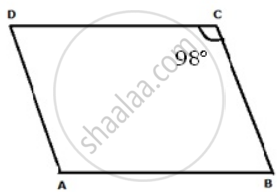
In a parallelogram ABCD ∠C = 98°. Find ∠A and ∠B.
Advertisements
Solution

ABCD is a parallelogram
∠C = 98°
∴ ∠A = ∠C = 98° ....(opposite angles of a parallelogram are equal)
∠A + ∠B +∠C + ∠D = 360° ....(Sum of all angles of a quadrilateral = 360°)
98° + ∠B + 98° + ∠D = 360°
∠B + 196 + ∠D = 360°
∠B + ∠D = 360° - 196°
∠B +∠D = 164°
But ∠B = ∠D ....(opposite angles of a parallelogram are equal)
⇒ 2∠B = 164°
⇒ ∠B = 82° = ∠D
Therefore,
∠B = 82°, ∠A = 98°.
APPEARS IN
RELATED QUESTIONS
In the following figure, ABCD and PQRS are two parallelograms such that ∠D = 120° and ∠Q = 70°.
Find the value of x.
In the given figure, AP is the bisector of ∠A and CQ is the bisector of ∠C of parallelogram ABCD. 
Prove that APCQ is a parallelogram.
In the following figures, find the remaining angles of the parallelogram
In the given figure, ABCD is a parallelogram, find the values of x and y.
PQR is a triangle formed by the adjacent sides PQ and QR and diagonal PR of a parallelogram PQRS. If in ΔPQR, ∠P : ∠Q : ∠R = 3 : 8 : 4, Calculate the measures of all the angles of parallelogram PQRS.

If PQRS is a parallelogram, then ∠P – ∠R is equal to ______.
In the given parallelogram YOUR, ∠RUO = 120° and OY is extended to point S such that ∠SRY = 50°. Find ∠YSR.