Advertisements
Advertisements
Question
In 1717, the Mughal emperor granted the United East India Company the right to carry on duty-free trade in ______, ______, and ______.
Advertisements
Solution
In 1717, the Mughal emperor granted the United East India Company the right to carry on duty-free trade in Bengal, Bihar, and Orissa.
APPEARS IN
RELATED QUESTIONS
Answer the following question in one or two words/sentences:
State the political significance of the Battle of Buxar.
Answer the following question briefly:
The Battle of Plassey was a major turning point in the history of India. In this context answer the following question:
Why is this battle considered a major turning point in the history of India?
Answer the following question briefly:
Mir Qasim was a competent ruler, determined to free himself from foreign control. In this context answer the following:
Trace the events from the outbreak of war (1763) between Mir Qasim and the British up to the Battle of Buxar in 1764.
Answer the following question briefly:
With reference to the Treaty of Allahabad and its impact, answer the following:
Explain how the treaty between Robert Clive and the Mughal emperor Shah Alam II legalized English East India’s Company’s control over Bengal.
This picture portrays a momentous event in 1765, involving a British Governor and a Mughal emperor wherein the Mughal emperor is conveying the grant of the Diwani to the governor.
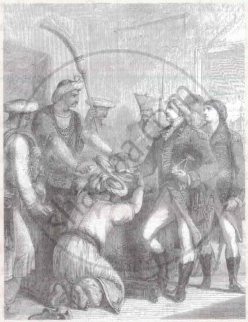
Give a brief account of the battle that preceded this event. When did it take place?
What plot did Robert Clive hatch to remove Siraj-ud- Daulah?
Why did Siraj-ud-Daulah lose the Battle of Plassey?
When and between whom was the Battle of Buxar fought?
Answer the following question:
Why did Mir Jafar enter into a conflict with the English East India Company?
Answer the following question:
What were the causes and results of the First Anglo-Maratha War? When was it fought?
