Advertisements
Advertisements
Question
If you had to make some rules for grown-ups to follow, what would you say? Make at least five such rules. Arrange the lines as in a poem.
Advertisements
Solution
Don’t dictate and impose your rules. Your ways and thinking is different from ours and so are the times. Don’t talk over the phone while eating. Please spend some time with us.
RELATED QUESTIONS
Think about the Text
Discuss in pairs and answer question below in a short paragraph (30 − 40 words).
“I looked into the mirror and smiled,” says the doctor. A little later he says, “I forgot my danger and smiled feebly at myself.” What is the doctor’s opinion about himself when:
(i) he first smiles, and
(ii) he smiles again? In what way do his thoughts change in between, and why?
Answer these question in one or two sentences . (The paragraph numbers within brackets provide clues to the answer.)
Why did Santosh’s parents agree to pay for her schooling in Delhi? What mental qualities of Santosh are brought into light by this incident?
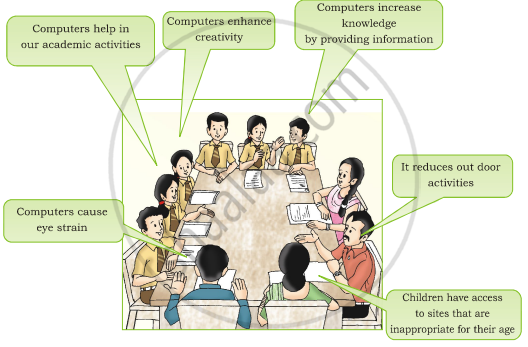
This is a meeting of the school’s Parent-Teacher Association. Some student representatives have also been invited to participate to discuss the role that Information technology/computers play in the growth and development of children.
What does he plant who plants a tree?
He plants, in sap and leaf and wood,
In love of home and loyalty
And far-cast thought of civic good____
His blessing on the neighbourhood,
Who in the hollow of his hand
Holds all the growth of all our land____
A nation's growth from sea to sea
Stirs in his heart who plants a tree.
Read the lines given above and answer the question that follow:
How is the man holding the blessing on his neighborhood in his hand?
“So that is what you are doing out here? A marshal!” “My dear Miss Fairchild,” said ’ Easton, calmly, “I had to do something. Money has & way of taking wings unto itself, and
you know it takes money to keep step with our crowd in Washington. I saw this opening in the West, and—well, a marshalship isn’t quite as high a position as that of ambassador, but—” “The ambassador,” said the girl, warmly, “doesn’t call any more. He needn’t ever have done so. You ought to know that. And so now you are one of these dashing Western heroes, and you ride and shoot and go into all kinds of dangers. That’s different from the Washington life. You have been missed from the old crowd.” The girl’s eyes, fascinated, went back, widening a little, to rest upon the glittering handcuffs. “Don’t you worry about them, miss,” said the other man. “All marshals handcuff themselves to their prisoners to keep them from getting away. Mr. Easton knows his business.” “Will we see you again soon in Washington?” asked the girl. “Not soon, I think,” said Easton. “My butterfly days are over, I fear.”
Read the extract given below and answer the question that follow.
What reason does Easton give for not keeping up with their crowd in Wahington?
Beside him in the shoals as he lay waiting glimmered a blue gem. It was not a gem, though: it was sand—?worn glass that had been rolling about in the river for a long time. By chance, it was perforated right through—the neck of a bottle perhaps?—a blue bead. In the shrill noisy village above the ford, out of a mud house the same colour as the ground came a little girl, a thin starveling child dressed in an earth—?coloured rag. She had torn the rag in two to make skirt and sari. Sibia was eating the last of her meal, chupatti wrapped round a smear of green chilli and rancid butter; and she divided this also, to make
it seem more, and bit it, showing straight white teeth. With her ebony hair and great eyes, and her skin of oiled brown cream, she was a happy immature child—?woman about twelve years old. Bare foot, of course, and often goosey—?cold on a winter morning, and born to toil. In all her life, she had never owned anything but a rag. She had never owned even one anna—not a pice.
Why does the writer mention the blue bead at the same time that the crocodile is introduced?
Ans. The author mentions the blue bead at the same time that the crocodile is introduced to create suspense and a foreshadowing of the events’to happen.
Read the extract given below and answer the question that follow.
Describe Sibia.
Read the extract given below and answer the questions that follow:
Duke: What, is Antonio here?
Antonio: Ready, so please your grace.
Duke: I am sorry for thee: thou art come to answer
A stony adversary, an inhuman wretch
Incapable of pity, void and empty
From any dram of mercy.
(i) What are the terms of the bond that Antonio has signed?
(ii) Why does the Duke call Shylock ‘inhuman’? What does the Duke expect Shylock to do?
(iii) What reason does Shylock give for choosing rotten flesh over money? What are the things hated by some people?
(iv) State three examples Antonio gives to illustrate Shylock’s stubborn attitude.
(v) How is Shylock’s property distributed at the end by Antonio? Do you think Shylock deserves the punishment given to him? Give a reason to justify your answer.
Read the extract given below and answer the questions that follow:
Trotter: Yes. You've been extraordinarily foolish, you know. You've run a very good chance of being killed by holding out on me. As a result, you've been in serious danger more than once.
Mollie: I don't know what you mean.
Trotter: (moving slowly above the sofa table to the Right of the sofa, still quite natural and friendly) Come now, Mrs. Ralston. We, policemen, aren't quite so dumb as you think. All along I've realized that you had first-hand knowledge of the Langridge Farm affair. You know Mrs. Boyle was the magistrate concerned. In fact, you knew all about it. Why didn't you speak up and say so?
Mollie: (Very much affected) I don't understand. I wanted to forget-forget. (She sits at the Left end of the sofa.)
(i) What was the 'Longridge Farm' affair?
(ii) Trotter revealed to Mollie some facts that he had uncovered about her past. What were they?
(iii) What did Mollie want to forget? How was she linked with the ‘Longridge Farm affair’?
(iv) How did Trotter manage a pass himself off as a policeman? How had he reached Monkswell Manor?
(v) What did Trotter reveal to Mollie about this true identity? How was Mollie saved at the end of the play?
Do we usually say that an animal ‘wears’ a tail? What do we say? (Think: Does an animal wear a coat? Consulta dictionary if you like, and find out how ‘wear’ is used in different ways
How did the mongoose prove his friendly nature?
Multiple Choice Question:
A family is made of the people who ________
Why did the magic waterfall disappoint other villagers? What reward did Taro get and from whom?
What does he want to know about his teacher? Why?
Talk to your partner and say whether the following statement is true or false.
Camels store water in their humps.
Multiple Choice Question:
How are words related to ideas?
Multiple Choice Question:
Which of the fears is not applied to the speaker?
The lane is dark and lonely because __________.
Can there be a good reason behind staying silent when everybody is talking?
Read the following conversation.
Ravi: What are you doing?
Mridu: I’m reading a book.
Ravi: Who wrote it?
Mridu: Ruskin Bond.
Ravi: Where did you find it?
Mridu: In the library.
Notice that ‘what’, ‘who’, ‘where’, are question words. Questions that require information begin with question words. Some other question words are ‘when’, ‘why’, ‘where’, ‘which’ and ‘how’.
Remember that
- What asks about acting, things etc.
- Who asks about people.
- Which asks about people or things.
- Where asks about place.
- When asks about time.
- Why asks about reason or purpose.
- How asks about means, manner or degree.
- Whose asks about possessions.
Read the following paragraph and frame questions on the italicised phrases.
Anil is in school. I am in school too. Anil is sitting in the left row. He is reading a book. Anil’s friend is sitting in the second row. He is sharpening his pencil. The teacher is writing on the blackboard. Children are writing in their copybooks. Some children are looking out of the window.
Complete the following sentence by providing a reason.
In the short story, Atithi, Motilal Babu and Annapurna choose Tarapada as a prospective groom for their daughter because ______.
