Advertisements
Advertisements
Question
If the sum of two smaller sides of a right – angled triangle is 17cm and the perimeter is 30cm, then find the area of the triangle.
Advertisements
Solution
The perimeter of the triangle = 30cm.
Let one of the two small sides = x
then, other side = 17 – x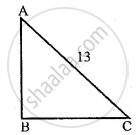
∴ Length of hypotenuse
= perimeter - sum of other two sides
= 30cm - 17cm
= 13cm.
x2 + (17 - x)2 = (13)2 ...(Pythagoras theorem)
⇒ x2 + 289 + x2 - 34x = 169
⇒ 2x2 - 34x + 289 - 169 = 0
⇒ 2x2 - 34x + 120 = 0
⇒ x2 - 17x + 60 = 0 ...(Dividing by 2)
⇒ x2 - 12x - 5x + 60 = 0
⇒ x(x - 12) - 5(x - 12) = 0
⇒ (x - 12)(x - 5) = 0
Either x - 12 = 0,
then x = 12
or
x - 5 = 0,
then x = 5
(i) when x = 12, then first side = 12cm
and second side = 17 - 12 = 5cm
(ii) When x = 5, then first side = 5
and second side = 17 - 5 = 12
∴ Sides are 5cm. 12cm
Now, area of the triangle
= `(5 xx 12)/(2)`
= `(60)/(2)`
= 30cm2.
APPEARS IN
RELATED QUESTIONS
Solve for x
:`1/((x-1)(x-2))+1/((x-2)(x-3))=2/3` , x ≠ 1,2,3
Solve the following quadratic equations by factorization:
(x − 4) (x + 2) = 0
Solve the following quadratic equations by factorization:
4x2 + 5x = 0
Solve the following quadratic equations by factorization:
`x^2 + (a + 1/a)x + 1 = 0`
Solve:
(a + b)2x2 – (a + b)x – 6 = 0; a + b ≠ 0
Solve the following quadratic equations by factorization:
\[16x - \frac{10}{x} = 27\]
Let ∆ ABC ∽ ∆ DEF and their areas be respectively, 64 cm2 and 121 cm2. If EF = 15⋅4 cm, find BC.
Solve the following equation by factorization
a2x2 + (a2+ b2)x + b2 = 0, a ≠ 0
Find two consecutive integers such that the sum of their squares is 61
A dealer sells a toy for ₹ 24 and gains as much percent as the cost price of the toy. Find the cost price of the toy.
