Advertisements
Advertisements
Question
Read the following information carefully and choose the appropriate option in the questions given below:
i. Six flats on a floor in two rows facing North and South are allotted to P, Q, R, S, T and U.
ii. Q gets a North facing flat and is not next to S.
iii. S and U get diagonally opposite flats.
iv. R, next to U gets a Southfacing flat and T gets a Northfacing flat
If the flats of T and P are interchanged, who’s flat will be next to that of U?
Options
Q
T
R
P
Advertisements
Solution
P
Explanation:
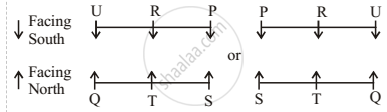
If the flats of T and P are interchanged, then R flat will be the next to that of U.
APPEARS IN
RELATED QUESTIONS
Direction: Read the following and answer the Question.
Chetan invited five of his friends, namely Ritwik, Avantika, Darshan, Parul and Shweta to his birthday party. Each of the five friends gifted Chetan a different article – a jacket, a watch, a shirt, a video game, and a headphone. As a return gift, Chetan gifted each of them a different article – goggles, a bag, a pen, a mobile case, and a diary. The following is additional information about the gifts given by the friends and the return gifts they received.
i. Avantika gifted the shirt but did not receive a bag in return.
ii. Shweta did not gift the headphone but received the mobile case in return.
iii. Neither Ritwik nor Darshan gifted the jacket but the person who did gift it received the goggles in return.
iv. The person who gifted the video game received a diary or a bag.
v. Darshan did not gift a watch but received a pen in return.
vi. Neither Shweta gifted a video game nor did Ritwik received a diary in return.
Which among the following combination is correct?
- P, Q, R, S, T, U, V and W are sitting around the circle and are facing the centre:
- P is second to the right of T who is the neighbour of R and V.
- S is not the neighbour of P.
- V is the neighbour of U.
- Q is not between S and W. W is not between U and S.
Which two of the following are not neighbours?
- P, Q, R, S, T, U, V and W are sitting around the circle and are facing the centre:
- P is second to the right of T who is the neighbour of R and V.
- S is not the neighbour of P.
- V is the neighbour of U.
- Q is not between S and W. W is not between U and S.
Which one is immediate right to the V?
Six friends are sitting in a circle and are facing the center of the circle. Deepa is between Prakash and Pankaj. Priti is between Mukesh and Lalit. Prakash and Mukesh are opposite to each other.
Who is just right to Pankaj?
Read the following information given below to answer the question
P, Q, R, S, T, and X are six persons who decided to start a partnership business in computer hardware. Q, R, and T are ladies and the rest are men. P, Q, R, and X are well versed in hardware but the others do not know much about the hardware. Q, X, and S know marketing but others do not know anything about marketing.
The male partner who knows marketing but does not know computer hardware is
Study the following information carefully and answer the question
P, Q, R, S, T, V and W are seven students of a college. Each of them has a favourite subject from Physics, Chemistry, English, Biology, History, Geography and Philosophy, not necessarily in the same order. Each of them also has a favourite sport from Football, Cricket, Hockey, Volleyball, Badminton, Table Tennis and Basketball, not necessarily in the same order. R likes Philosophy and his favourite sport is Hockey. The one who likes Football likes English. T's favourite sport is not Badminton or Table Tennis. V does not like either History or Biology. The one whose favourite sport is Basketball does not like Physics. W likes Chemistry and his favourite sport is Volleyball. S likes Geography. Q's favourite sport is Badminton. V does not like English and his favourite sport is not Basketball. P's favourite sport is Cricket. The one whose favourite sport is Badminton does not like Biology.
Who likes History?
Study the following information carefully and answer the question
P, Q, R, S, T, V and W are seven students of a college. Each of them has a favourite subject from Physics, Chemistry, English, Biology, History, Geography and Philosophy, not necessarily in the same order. Each of them also has a favourite sport from Football, Cricket, Hockey, Volleyball, Badminton, Table Tennis and Basketball, not necessarily in the same order. R likes Philosophy and his favourite sport is Hockey. The one who likes Football likes English. T's favourite sport is not Badminton or Table Tennis. V does not like either History or Biology. The one whose favourite sport is Basketball does not like Physics. W likes Chemistry and his favourite sport is Volleyball. S likes Geography. Q's favourite sport is Badminton. V does not like English and his favourite sport is not Basketball. P's favourite sport is Cricket. The one whose favourite sport is Badminton does not like Biology.
Which subject does T like?
Read the following information carefully and answer the question
You want to expand your horizons and decide to go to the village of "Where is Who" which is deep inside the island. You come to the border of "Kya Kya" and see a road sign. One leads to the left and the other right. There are no other roads. You ask the inhabitants.
Maroof: I do not speak to strangers. I am new to these parts.
Nafish: Take the road to the right. I am married to Ayesha.
Ayesha : I am not Nafish's wife. Maroof is not new to these parts.
Which one of the following is true?
Read the following information to answer the question
From a group of six boys M, N, O, P, Q, and Rand five girls G, H, I, J, and K a team of six are to be selected. Some of the criteria for selection are as follows.
- M and J go together.
- O cannot be placed with N.
- I cannot go with J.
- No goes with H.
- P and Q have to be together.
- K and R go together.
- Unless otherwise stated these criteria are applicable to the following question.
If the team has three girls including J and K, the members of the team other than J and K are
Count the number of F in the given sentence. The flower of a fulfilling tree filled the freely available puffy furnace of Fatima's father.
