Advertisements
Advertisements
प्रश्न
Read the following information carefully and choose the appropriate option in the questions given below:
i. Six flats on a floor in two rows facing North and South are allotted to P, Q, R, S, T and U.
ii. Q gets a North facing flat and is not next to S.
iii. S and U get diagonally opposite flats.
iv. R, next to U gets a Southfacing flat and T gets a Northfacing flat
If the flats of T and P are interchanged, who’s flat will be next to that of U?
विकल्प
Q
T
R
P
Advertisements
उत्तर
P
Explanation:
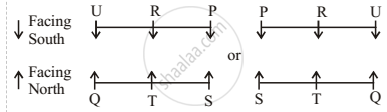
If the flats of T and P are interchanged, then R flat will be the next to that of U.
APPEARS IN
संबंधित प्रश्न
Direction: Read the following and answer the Question.
Chetan invited five of his friends, namely Ritwik, Avantika, Darshan, Parul and Shweta to his birthday party. Each of the five friends gifted Chetan a different article – a jacket, a watch, a shirt, a video game, and a headphone. As a return gift, Chetan gifted each of them a different article – goggles, a bag, a pen, a mobile case, and a diary. The following is additional information about the gifts given by the friends and the return gifts they received.
i. Avantika gifted the shirt but did not receive a bag in return.
ii. Shweta did not gift the headphone but received the mobile case in return.
iii. Neither Ritwik nor Darshan gifted the jacket but the person who did gift it received the goggles in return.
iv. The person who gifted the video game received a diary or a bag.
v. Darshan did not gift a watch but received a pen in return. vi. Neither Shweta gifted a video game nor did Ritwik received a diary in return.
Which among the following combination is correct?
There are 7 children A, B, C, D, E, F and G who secured different marks in a class test.
A is secured more than D but less than G. F is secured more than only B and C.
E secured the highest marks.
The one who is secured the second lowest marks secured 44 and the one who is secured the second highest marks secured 72 marks.
How many persons are secured more marks than A?
Read the following information carefully and answer the question
Surinder, Prem, Wasim, Bishamber, and Chauhan are five players of a college cricket team and their home towns are Sikandrabad, Panipat, Waranga, Banaras, and Chennai (not in the order of their names). The five specialist slots of a spinner, pace-bowler, wicket-keeper, batsman, and captain are held by them (not in order of their names stated above). Their names, home towns, and specialties do not start with the same letter. Neither Prem nor Wasim is the captain and they do not belong to either Sik.amlrabad or Banaras. Panipat is not Bishambers home town. The player who hails from Banaras is a wicket-keeper. The captain's town in Panipat while the batsman does not hail from Warangal. Surinder is neither a wicket-keeper nor a batsman.
The captain's home town is
Study the following information carefully to answer the given question
Six plays are to be organized from Monday to Sunday, one play each day with one day when there is no play. 'No play' day is not Monday or Sunday.
The plays are held in sets of 3 plays each in such a way that 3 plays are held without any break, i.e. 3 plays are held in such a way that there is no 'no play' day between them but immediately before this set or immediately after this set it is 'no play' day. Play Z was held on 26th and play X was held on 31st of the same month. Play B was not held immediately after play A but was held after A and play M was held immediately before Q. All the six plays were held in the same month.
Which of the following is true?
Choose the response that most accurately and completely answers the following question.
A Science student has exactly four flasks - 1, 2, 3, and 4 - originally containing a red, a blue, a green, and an orange chemical, respectively. An experiment consists of mixing exactly two of these chemicals together by completely emptying the contents of one of the flasks into another of the flasks. The following conditions apply
The product of an experiment cannot be used in further experiments.
Mixing the contents of 1 and 2 produces a red chemical.
Mixing the contents of 2 and 3 produces an orange chemical.
Mixing the contents of 3 with the contents of either 1 or 4 produces a blue chemical.
Mixing the contents of 4 with the contents of either 1 or 2 produces a green chemical.
If the student performs exactly one experiment, then which one of the following could be the colors of the chemicals in resulting three non-empty flasks?
Choose the response that most accurately and completely answers the following question.
A Science student has exactly four flasks - 1, 2, 3, and 4 - originally containing a red, a blue, a green, and an orange chemical, respectively. An experiment consists of mixing exactly two of these chemicals together by completely emptying the contents of one of the flasks into another of the flasks. The following conditions apply
The product of an experiment cannot be used in further experiments.
Mixing the contents of 1 and 2 produces a red chemical.
Mixing the contents of 2 and 3 produces an orange chemical.
Mixing the contents of 3 with the contents of either 1 or 4 produces a blue chemical.
Mixing the contents of 4 with the contents of either 1 or 2 produces a green chemical.
If the student performs exactly one experiment and none of the resulting three non-empty flasks contains an orange chemical, then the student must have mixed the contents of
According to the time by Rekha's watch, it is quarter past 9 and the hour-hand is pointing to the west. ln which of the given directions will the minute-hand point AFTER 75 minutes?
Select the option that is related to the third number in the same way as the second number is related to the first number.
7 : 294 : : 9 : ?
Study the following information carefully and answer the given questions:
L, P, Q, R, Sand Tare sitting in a straight line facing North.
- Q sits fourth to the left of T and Q does not sit at an extreme end of the line.
- R is not an immediate neighbour of Q.
- Only one person sits between R and T.
- Neither S nor L sits at the extreme end of the line.
- L is not an immediate neighbour of Q.
Four of the following five are alike in a certain way based on their seating positions in the above arrangement and so form a group. Which is the one that does not belong to that group?
Study the following information carefully and answer the given questions.
L, P, Q, R, S, T and W are sitting in a straight line facing North.
- P sits fourth to the left of L and L sits second to the left of Q.
- R, who is not an immediate neighbour of L, sits to the immediate right of S.
- T sits second to the left of W.
Four of the following five are alike in a certain way based on their seating positions in the above arrangement and so form a group. Which is the one that does not belong to that group?
