Advertisements
Advertisements
Question
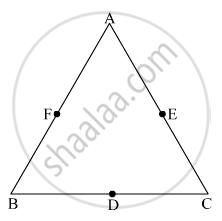
If O is a point in space, ABC is a triangle and D, E, F are the mid-points of the sides BC, CA and AB respectively of the triangle, prove that \[\vec{OA} + \vec{OB} + \vec{OC} = \vec{OD} + \vec{OE} + \vec{OF}\]
Advertisements
Solution

Let D, E and F are the midpoints of BC, CA and AB respectively.
Therefore,
\[\frac{\vec{OB} + \vec{OC}}{2} = \vec{OD}\]
\[\vec{OB} + \vec{OC} = 2 \vec{OD} . . . . . \left( 1 \right)\]
Similarly,
\[ \vec{OC} + \vec{OA} = 2 \vec{OE} . . . . . \left( 2 \right)\]
\[ \vec{OA} + \vec{OB} = 2 \vec{OF} . . . . . \left( 3 \right)\]
Adding (1), (2) and (3). We get,
\[2 ( \vec{OA} + \vec{OB} + \vec{OC} ) = 2 ( \vec{OD} + \vec{OE} + \vec{OF} ) . \]
\[ \Rightarrow \vec{OA} + \vec{OB} + \vec{OC} = \vec{OD} + \vec{OE} + \vec{OF} .\]
Hence Proved.
APPEARS IN
RELATED QUESTIONS
Answer the following as true or false:
Two collinear vectors are always equal in magnitude.
Answer the following as true or false:
Zero vector is unique.
Answer the following as true or false:
Two collinear vectors having the same magnitude are equal.
If \[\vec{a}\] is a vector and m is a scalar such that m \[\vec{a}\] = \[\vec{0}\], then what are the alternatives for m and \[\vec{a}\] ?
Five forces \[\overrightarrow{AB,} \overrightarrow { AC,} \overrightarrow{ AD,}\overrightarrow{AE}\] and \[\overrightarrow{AF}\] act at the vertex of a regular hexagon ABCDEF. Prove that the resultant is 6 \[\overrightarrow{AO,}\] where O is the centre of hexagon.
If the vectors \[\vec{a} = 2 \hat{i} - 3 \hat{j}\] and \[\vec{b} = - 6 \hat{i} + m \hat{j}\] are collinear, find the value of m.
Show that the points A (1, −2, −8), B (5, 0, −2) and C (11, 3, 7) are collinear, and find the ratio in which B divides AC.
Using vectors show that the points A (−2, 3, 5), B (7, 0, −1) C (−3, −2, −5) and D (3, 4, 7) are such that AB and CD intersect at the point P (1, 2, 3).
If \[\vec{a}\], \[\vec{b}\], \[\vec{c}\] are non-zero, non-coplanar vectors, prove that the following vectors are coplanar:
(1) \[5 \vec{a} + 6 \vec{b} + 7 \vec{c,} 7 \vec{a} - 8 \vec{b} + 9 \vec{c}\text{ and }3 \vec{a} + 20 \vec{b} + 5 \vec{c}\]
Prove that the following vectors are coplanar:
\[2 \hat{i} - \hat{j} + \hat{k} , \hat{i} - 3 \hat{j} - 5 \hat{k} \text{ and }3 \hat{i} - 4 \hat{j} - 4 \hat{k}\]
Prove that the following vectors are coplanar:
\[\hat{i} + \hat{j} + \hat{k} , 2 \hat{i} + 3 \hat{j} - \hat{k}\text{ and }- \hat{i} - 2 \hat{j} + 2 \hat{k}\]
Prove that the following vectors are non-coplanar:
If \[\vec{a}\], \[\vec{a}\], \[\vec{c}\] are non-coplanar vectors, prove that the following vectors are non-coplanar: \[2 \vec{a} - \vec{b} + 3 \vec{c} , \vec{a} + \vec{b} - 2 \vec{c}\text{ and }\vec{a} + \vec{b} - 3 \vec{c}\]
Show that the vectors \[\vec{a,} \vec{b,} \vec{c}\] given by \[\vec{a} = \hat{i} + 2 \hat{j} + 3 \hat{k} , \vec{b} = 2 \hat{i} + \hat{j} + 3 \hat{k}\text{ and }\vec{c} = \hat{i} + \hat{j} + \hat{k}\] are non coplanar.
Express vector \[\vec{d} = 2 \hat{i}-j- 3 \hat{k} , \text{ and }\text { as a linear combination of the vectors } \vec{a,} \vec{b}\text{ and }\vec{c} .\]
The vectors \[\vec{a} \text{ and } \vec{b}\] satisfy the equations \[2 \vec{a} + \vec{b} = \vec{p} \text{ and } \vec{a} + 2 \vec{b} = \vec{q} , \text{ where } \vec{p} = \hat{i} + \hat{j} \text{ and } \vec{q} = \hat{i} - \hat{j} .\] the angle between \[\vec{a} \text{ and } \vec{b}\] then
If \[\vec{a} \cdot \text{i} = \vec{a} \cdot \left( \hat{i} + \hat{j} \right) = \vec{a} \cdot \left( \hat{i} + \hat{j} + \hat{k} \right) = 1,\] then \[\vec{a} =\]
Let \[\vec{a} \text{ and } \vec{b}\] be two unit vectors and α be the angle between them. Then, \[\vec{a} + \vec{b}\] is a unit vector if
If \[\vec{a} + \vec{b} + \vec{c} = \vec{0} , \left| \vec{a} \right| = 3, \left| \vec{b} \right| = 5, \left| \vec{c} \right| = 7,\] then the angle between \[\vec{a} \text{ and } \vec{b}\] is
If the position vectors of P and Q are \[\hat{i} + 3 \hat{j} - 7 \hat{k} \text{ and } 5 \text{i} - 2 \hat{j} + 4 \hat{k}\] then the cosine of the angle between \[\vec{PQ}\] and y-axis is
If the vectors `hati - 2xhatj + 3 yhatk and hati + 2xhatj - 3yhatk` are perpendicular, then the locus of (x, y) is ______.
The vector component of \[\vec{b}\] perpendicular to \[\vec{a}\] is
If θ is the angle between two vectors `veca` and `vecb` then, `veca * vecb` ≥ 0, only when
The projection of the vector \[\hat{i} + \hat{j} + \hat{k}\] along the vector of \[\hat{j}\] is
If \[\vec{a} \text{ and } \vec{b}\] are unit vectors, then the greatest value of \[\sqrt{3}\left| \vec{a} + \vec{b} \right| + \left| \vec{a} - \vec{b} \right|\]
If the angle between the vectors \[x \hat{i} + 3 \hat{j}- 7 \hat{k} \text{ and } x \hat{i} - x \hat{j} + 4 \hat{k}\] is acute, then x lies in the interval
If \[\vec{a} \text{ and } \vec{b}\] are two unit vectors inclined at an angle θ, such that \[\left| \vec{a} + \vec{b} \right| < 1,\] then
Let \[\vec{a} , \vec{b} , \vec{c}\] be three unit vectors, such that \[\left| \vec{a} + \vec{b} + \vec{c} \right|\] =1 and \[\vec{a}\] is perpendicular to \[\vec{b}\] If \[\vec{c}\] makes angles α and β with \[\vec{a} and \vec{b}\] respectively, then cos α + cos β =
If \[\vec{a} \text{ and }\vec{b}\] be two unit vectors and θ the angle between them, then \[\vec{a} + \vec{b}\] is a unit vector if θ =
In Figure ABCD is a regular hexagon, which vectors are:
(i) Collinear
(ii) Equal
(iii) Coinitial
(iv) Collinear but not equal.
Which of the following quantities requires both magnitude (size) and direction for its complete description?
Two cars are moving at 50 km/h toward Mumbai from different cities. Are their velocity vectors equal? Why?
What is a position vector?
In the graphical representation of a vector, what does the arrow length represent?