Advertisements
Advertisements
प्रश्न
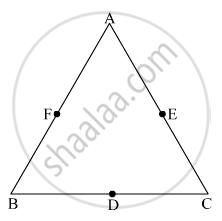
If O is a point in space, ABC is a triangle and D, E, F are the mid-points of the sides BC, CA and AB respectively of the triangle, prove that \[\vec{OA} + \vec{OB} + \vec{OC} = \vec{OD} + \vec{OE} + \vec{OF}\]
Advertisements
उत्तर

Let D, E and F are the midpoints of BC, CA and AB respectively.
Therefore,
\[\frac{\vec{OB} + \vec{OC}}{2} = \vec{OD}\]
\[\vec{OB} + \vec{OC} = 2 \vec{OD} . . . . . \left( 1 \right)\]
Similarly,
\[ \vec{OC} + \vec{OA} = 2 \vec{OE} . . . . . \left( 2 \right)\]
\[ \vec{OA} + \vec{OB} = 2 \vec{OF} . . . . . \left( 3 \right)\]
Adding (1), (2) and (3). We get,
\[2 ( \vec{OA} + \vec{OB} + \vec{OC} ) = 2 ( \vec{OD} + \vec{OE} + \vec{OF} ) . \]
\[ \Rightarrow \vec{OA} + \vec{OB} + \vec{OC} = \vec{OD} + \vec{OE} + \vec{OF} .\]
Hence Proved.
APPEARS IN
संबंधित प्रश्न
Classify the following measures as scalars and vectors:
(i) 15 kg
(ii) 20 kg weight
(iii) 45°
(iv) 10 meters south-east
(v) 50 m/sec2
Answer the following as true or false:
\[\vec{a}\] and \[\vec{a}\] are collinear.
Answer the following as true or false:
Two collinear vectors are always equal in magnitude.
Answer the following as true or false:
Zero vector is unique.
If \[\vec{a}\] and \[\vec{b}\] are two non-collinear vectors having the same initial point. What are the vectors represented by \[\vec{a}\] + \[\vec{b}\] and \[\vec{a}\] − \[\vec{b}\].
Five forces \[\overrightarrow{AB,} \overrightarrow { AC,} \overrightarrow{ AD,}\overrightarrow{AE}\] and \[\overrightarrow{AF}\] act at the vertex of a regular hexagon ABCDEF. Prove that the resultant is 6 \[\overrightarrow{AO,}\] where O is the centre of hexagon.
Show that the points (3, 4), (−5, 16) and (5, 1) are collinear.
If the vectors \[\vec{a} = 2 \hat{i} - 3 \hat{j}\] and \[\vec{b} = - 6 \hat{i} + m \hat{j}\] are collinear, find the value of m.
Show that the points A (1, −2, −8), B (5, 0, −2) and C (11, 3, 7) are collinear, and find the ratio in which B divides AC.
Using vectors show that the points A (−2, 3, 5), B (7, 0, −1) C (−3, −2, −5) and D (3, 4, 7) are such that AB and CD intersect at the point P (1, 2, 3).
Prove that the following vectors are coplanar:
\[2 \hat{i} - \hat{j} + \hat{k} , \hat{i} - 3 \hat{j} - 5 \hat{k} \text{ and }3 \hat{i} - 4 \hat{j} - 4 \hat{k}\]
Prove that the following vectors are coplanar:
\[\hat{i} + \hat{j} + \hat{k} , 2 \hat{i} + 3 \hat{j} - \hat{k}\text{ and }- \hat{i} - 2 \hat{j} + 2 \hat{k}\]
If \[\vec{a}\], \[\vec{a}\], \[\vec{c}\] are non-coplanar vectors, prove that the following vectors are non-coplanar: \[2 \vec{a} - \vec{b} + 3 \vec{c} , \vec{a} + \vec{b} - 2 \vec{c}\text{ and }\vec{a} + \vec{b} - 3 \vec{c}\]
Show that the vectors \[\vec{a,} \vec{b,} \vec{c}\] given by \[\vec{a} = \hat{i} + 2 \hat{j} + 3 \hat{k} , \vec{b} = 2 \hat{i} + \hat{j} + 3 \hat{k}\text{ and }\vec{c} = \hat{i} + \hat{j} + \hat{k}\] are non coplanar.
Express vector \[\vec{d} = 2 \hat{i}-j- 3 \hat{k} , \text{ and }\text { as a linear combination of the vectors } \vec{a,} \vec{b}\text{ and }\vec{c} .\]
The vectors \[\vec{a} \text{ and } \vec{b}\] satisfy the equations \[2 \vec{a} + \vec{b} = \vec{p} \text{ and } \vec{a} + 2 \vec{b} = \vec{q} , \text{ where } \vec{p} = \hat{i} + \hat{j} \text{ and } \vec{q} = \hat{i} - \hat{j} .\] the angle between \[\vec{a} \text{ and } \vec{b}\] then
If \[\vec{a} \cdot \text{i} = \vec{a} \cdot \left( \hat{i} + \hat{j} \right) = \vec{a} \cdot \left( \hat{i} + \hat{j} + \hat{k} \right) = 1,\] then \[\vec{a} =\]
The vector (cos α cos β) \[\hat{i}\] + (cos α sin β) \[\hat{j}\] + (sin α) \[\hat{k}\] is a
If \[\vec{a} \text{ and } \vec{b}\] are unit vectors, then which of the following values of \[\vec{a} . \vec{b}\] is not possible?
If the vectors `hati - 2xhatj + 3 yhatk and hati + 2xhatj - 3yhatk` are perpendicular, then the locus of (x, y) is ______.
The vector component of \[\vec{b}\] perpendicular to \[\vec{a}\] is
What is the length of the longer diagonal of the parallelogram constructed on \[5 \vec{a} + 2 \vec{b} \text{ and } \vec{a} - 3 \vec{b}\] if it is given that \[\left| \vec{a} \right| = 2\sqrt{2}, \left| \vec{b} \right| = 3\] and the angle between \[\vec{a} \text{ and } \vec{b}\] is π/4?
The values of x for which the angle between \[\vec{a} = 2 x^2 \hat{i} + 4x \hat{j} + \hat{k} , \vec{b} = 7 \hat{i} - 2 \hat{j} + x \hat{k}\] is obtuse and the angle between \[\vec{b}\] and the z-axis is acute and less than \[\frac{\pi}{6}\] are
If the vectors \[3 \hat{i} + \lambda \hat{j} + \hat{k} \text{ and } 2 \hat{i} - \hat{j} + 8 \hat{k}\] are perpendicular, then λ is equal to
If \[\left| \vec{a} \right| = \left| \vec{b} \right|, \text{ then } \left( \vec{a} + \vec{b} \right) \cdot \left( \vec{a} - \vec{b} \right) =\]
If \[\vec{a} \text{ and } \vec{b}\] are unit vectors inclined at an angle θ, then the value of \[\left| \vec{a} - \vec{b} \right|\]
If \[\vec{a} \text{ and } \vec{b}\] are two unit vectors inclined at an angle θ, such that \[\left| \vec{a} + \vec{b} \right| < 1,\] then
Let \[\vec{a} , \vec{b} , \vec{c}\] be three unit vectors, such that \[\left| \vec{a} + \vec{b} + \vec{c} \right|\] =1 and \[\vec{a}\] is perpendicular to \[\vec{b}\] If \[\vec{c}\] makes angles α and β with \[\vec{a} and \vec{b}\] respectively, then cos α + cos β =
If \[\vec{a} \text{ and }\vec{b}\] be two unit vectors and θ the angle between them, then \[\vec{a} + \vec{b}\] is a unit vector if θ =
What is a position vector?
In the graphical representation of a vector, what does the arrow length represent?