Advertisements
Advertisements
Question
If a machine is correctly set up it produces 90% acceptable items. If it is incorrectly set up it produces only 40% acceptable item. Past experience shows that 80% of the setups are correctly done. If after a certain set up, the machine produces 2 acceptable items, find the probability that the machine is correctly set up.
Advertisements
Solution
Let A be the event that the machine produces two acceptable items.
Also, let E1 represent the event that the machine is correctly set up and E2 represent the event that the machine is incorrectly set up
\[\therefore P\left( E_1 \right) = 0 . 8 \]
\[ P\left( E_2 \right) = 0 . 2\]
\[\text{ Now } , \]
\[P\left( A/ E_1 \right) = 0 . 9 \times 0 . 9 = 0 . 81\]
\[P\left( A/ E_2 \right) = 0 . 40 \times 0 . 40 = 0 . 16\]
\[\text{ Using Bayes' theorem, we get } \]
\[\text{ Required probability } = P\left( E_1 /A \right) = \frac{P\left( E_1 \right)P\left( A/ E_1 \right)}{P\left( E_1 \right)P\left( A/ E_1 \right) + P\left( E_2 \right)P\left( A/ E_2 \right)}\]
\[ = \frac{0 . 8 \times 0 . 81}{0 . 8 \times 0 . 81 + 0 . 2 \times 0 . 16}\]
\[ = \frac{81}{85}\]
APPEARS IN
RELATED QUESTIONS
Two groups are competing for the position on the board of directors of a corporation. The probabilities that the first and the second groups will win are 0.6 and 0.4 respectively. Further, if the first group wins, the probability of introducing a new product is 0.7 and the corresponding probability is 0.3 if the second group wins. Find the probability that the new product introduced was by the second group.
A card from a pack of 52 cards is lost. From the remaining cards of the pack, two cards are drawn and are found to be both diamonds. Find the probability of the lost card being a diamond.
Of the students in a school, it is known that 30% have 100% attendance and 70% students are irregular. Previous year results report that 70% of all students who have 100% attendance attain A grade and 10% irregular students attain A grade in their annual examination. At the end of the year, one student is chos~n at random from the school and he was found ·to have an A grade. What is the probability that the student has 100% attendance? Is regularity required only in school? Justify your answer
Often it is taken that a truthful person commands, more respect in the society. A man is known to speak the truth 4 out of 5 times. He throws a die and reports that it is a six. Find the probability that it is actually a six.
Do you also agree that the value of truthfulness leads to more respect in the society?
A bag A contains 2 white and 3 red balls and a bag B contains 4 white and 5 red balls. One ball is drawn at random from one of the bags and is found to be red. Find the probability that it was drawn from bag B.
The contents of three urns are as follows:
Urn 1 : 7 white, 3 black balls, Urn 2 : 4 white, 6 black balls, and Urn 3 : 2 white, 8 black balls. One of these urns is chosen at random with probabilities 0.20, 0.60 and 0.20 respectively. From the chosen urn two balls are drawn at random without replacement. If both these balls are white, what is the probability that these came from urn 3?
Suppose 5 men out of 100 and 25 women out of 1000 are good orators. An orator is chosen at random. Find the probability that a male person is selected. Assume that there are equal number of men and women.
An item is manufactured by three machines A, B and C. Out of the total number of items manufactured during a specified period, 50% are manufactured on machine A, 30% on Band 20% on C. 2% of the items produced on A and 2% of items produced on B are defective and 3% of these produced on C are defective. All the items stored at one godown. One item is drawn at random and is found to be defective. What is the probability that it was manufactured on machine A?
In a factory, machine A produces 30% of the total output, machine B produces 25% and the machine C produces the remaining output. If defective items produced by machines A, B and C are 1%, 1.2%, 2% respectively. Three machines working together produce 10000 items in a day. An item is drawn at random from a day's output and found to be defective. Find the probability that it was produced by machine B?
Coloured balls are distributed in four boxes as shown in the following table:
| Box | Colour | |||
| Black | White | Red | Blue | |
| I II III IV |
3 2 1 4 |
4 2 2 3 |
5 2 3 1 |
6 2 1 5 |
A box is selected at random and then a ball is randomly drawn from the selected box. The colour of the ball is black, what is the probability that ball drawn is from the box III.
A test for detection of a particular disease is not fool proof. The test will correctly detect the disease 90% of the time, but will incorrectly detect the disease 1% of the time. For a large population of which an estimated 0.2% have the disease, a person is selected at random, given the test, and told that he has the disease. What are the chances that the person actually have the disease?
If E1 and E2 are equally likely, mutually exclusive and exhaustive events and `"P"("A"/"E"_1 )` = 0.2, `"P"("A"/"E"_2)` = 0.3. Find `"P"("E"_1/"A")`
Jar I contains 5 white and 7 black balls. Jar II contains 3 white and 12 black balls. A fair coin is flipped; if it is Head, a ball is drawn from Jar I, and if it is Tail, a ball is drawn from Jar II. Suppose that this experiment is done and a white ball was drawn. What is the probability that this ball was in fact taken from Jar II?
2% of the population have a certain blood disease of a serious form: 10% have it in a mild form; and 88% don't have it at all. A new blood test is developed; the probability of testing positive is `9/10` if the subject has the serious form, `6/10` if the subject has the mild form, and `1/10` if the subject doesn't have the disease. A subject is tested positive. What is the probability that the subject has serious form of the disease?
A box contains three coins: two fair coins and one fake two-headed coin is picked randomly from the box and tossed. What is the probability that it lands head up?
There are three social media groups on a mobile: Group I, Group II and Group III. The probabilities that Group I, Group II and Group III sending the messages on sports are `2/5, 1/2`, and `2/3` respectively. The probability of opening the messages by Group I, Group II and Group III are `1/2, 1/4` and `1/4` respectively. Randomly one of the messages is opened and found a message on sports. What is the probability that the message was from Group III
Solve the following:
The chances of P, Q and R, getting selected as principal of a college are `2/5, 2/5, 1/5` respectively. Their chances of introducing IT in the college are `1/2, 1/3, 1/4` respectively. Find the probability that IT is introduced by Q
Solve the following:
In a factory which manufactures bulbs, machines A, B and C manufacture respectively 25%, 35% and 40% of the bulbs. Of their outputs, 5, 4 and 2 percent are respectively defective bulbs. A bulbs is drawn at random from the product and is found to be defective. What is the probability that it is manufactured by the machine B?
The chances of A, B and C becoming manager of a certain company are 5 : 3 : 2. The probabilities that the office canteen will be improved if A, B, and C become managers are 0.4, 0.5 and 0.3 respectively. If the office canteen has been improved, what is the probability that B was appointed as the manager?
The odds in favour of drawing a king from a pack of 52 playing cards is ______.
Suppose you have two coins which appear identical in your pocket. You know that one is fair and one is 2-headed. If you take one out, toss it and get a head, what is the probability that it was a fair coin?
Suppose that 6% of the people with blood group O are left handed and 10% of those with other blood groups are left handed 30% of the people have blood group O. If a left handed person is selected at random, what is the probability that he/she will have blood group O?
A shopkeeper sells three types of flower seeds A1, A2 and A3. They are sold as a mixture where the proportions are 4:4:2 respectively. The germination rates of the three types of seeds are 45%, 60% and 35%. Calculate the probability that it is of the type A2 given that a randomly chosen seed does not germinate.
An item is manufactured by three machines A, B and C. Out of the total number of items manufactured during a specified period, 50% are manufactured on A, 30% on B and 20% on C. 2% of the items produced on A and 2% of items produced on B are defective, and 3% of these produced on C are defective. All the items are stored at one godown. One item is drawn at random and is found to be defective. What is the probability that it was manufactured on machine A?
In a bolt factory, machines X, Y and Z manufacture 20%, 35% and 45% respectively of the total output. Of their output 8%, 6% and 5% respectively are defective bolts. One bolt is drawn at random from the product and is found to be defective. What is the probability that it was manufactured in machine Y?
| CASE-BASED/DATA-BASED |
 |
| An insurance company believes that people can be divided into two classes: those who are accident prone and those who are not. The company’s statistics show that an accident-prone person will have an accident at some time within a fixed one-year period with a probability 0.6, whereas this probability is 0.2 for a person who is not accident prone. The company knows that 20 percent of the population is accident prone. |
Based on the given information, answer the following questions.
- What is the probability that a new policyholder will have an accident within a year of purchasing a policy?
- Suppose that a new policyholder has an accident within a year of purchasing a policy. What is the probability that he or she is accident prone?
If 'A' and 'B' are two events such that A ⊂ B and P(B) ≠ 0, then which of the following is true :-
In a factory, machine A produces 30% of total output, machine B produces 25% and the machine C produces the remaining output. The defective items produced by machines A, B and C are 1%,1.2%, 2% respectively. An item is picked at random from a day's output and found to be defective. Find the probability that it was produced by machine B?
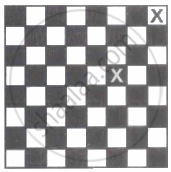
Let P denotes the probability of selecting one white and one black square from the chessboard so that they are not in the same row and also not in the same column (an example of this kind of the choice is shown in figure), then (1024)P is ______.
A speaks truth in 75% of the cases and B in 80% of the cases. The percentage of cases they are likely to contradict each other in making the same statement is ______.
The probability that A speaks truth is `4/5`, while the probability for B is `3/4`. The probability that they contradict each other when asked to speak on a fact is ______.
In an entrance test, there are multiple choice questions. There are four possible answers to each question, of which one is correct. The probability that a student knows the answer to a question is 90%. If he gets the correct answer to a question, then the probability that he was guessing is ______.
Why is Bayes' Theorem often called a method of finding reverse probability?
What does prior probability mean?
