Advertisements
Advertisements
Question
| CASE-BASED/DATA-BASED |
 |
| An insurance company believes that people can be divided into two classes: those who are accident prone and those who are not. The company’s statistics show that an accident-prone person will have an accident at some time within a fixed one-year period with a probability 0.6, whereas this probability is 0.2 for a person who is not accident prone. The company knows that 20 percent of the population is accident prone. |
Based on the given information, answer the following questions.
- What is the probability that a new policyholder will have an accident within a year of purchasing a policy?
- Suppose that a new policyholder has an accident within a year of purchasing a policy. What is the probability that he or she is accident prone?
Advertisements
Solution
Let E1 = The policyholder is accident prone.
E2 = The policyholder is not accident prone.
E = The new policyholder has an accident within a year of purchasing a policy.
i. `"P"("E") = "P"("E"_1) × "P"("E"/"E"_1) + "P"("E"_2) × "P"("E"/"E"_2)`
= `20/100 xx 6/10 + 80/100 xx 2/10`
= `7/25`
ii. By Bayes’ Theorem, `"P"("E"_1/"E") = ("P"("E"_1) xx "P"("E"/"E"_1))/("P"("E"))`
= `(20/100 xx 6/10)/(280/1000)`
= `3/7`
APPEARS IN
RELATED QUESTIONS
There are three coins. One is a two-headed coin (having head on both faces), another is a biased coin that comes up heads 75% of the times and the third is also a biased coin that comes up tails 40% of the time. One of the three coins is chosen at random and tossed and it shows heads. What is the probability that it was the two-headed coin?
There are three coins. One is two headed coin (having head on both faces), another is a biased coin that comes up heads 75% of the time and third is an unbiased coin. One of the three coins is chosen at random and tossed, it shows heads, what is the probability that it was the two headed coin?
An insurance company insured 2000 scooter drivers, 4000 car drivers and 6000 truck drivers. The probability of accidents are 0.01, 0.03 and 0.15 respectively. One of the insured persons meets with an accident. What is the probability that he is a scooter driver?
If A and B are two events such that A ⊂ B and P (B) ≠ 0, then which of the following is correct?
The contents of urns I, II, III are as follows:
Urn I : 1 white, 2 black and 3 red balls
Urn II : 2 white, 1 black and 1 red balls
Urn III : 4 white, 5 black and 3 red balls.
One urn is chosen at random and two balls are drawn. They happen to be white and red. What is the probability that they come from Urns I, II, III?
A bag A contains 2 white and 3 red balls and a bag B contains 4 white and 5 red balls. One ball is drawn at random from one of the bags and is found to be red. Find the probability that it was drawn from bag B.
A letter is known to have come either from LONDON or CLIFTON. On the envelope just two consecutive letters ON are visible. What is the probability that the letter has come from
(i) LONDON (ii) CLIFTON?
In a class, 5% of the boys and 10% of the girls have an IQ of more than 150. In this class, 60% of the students are boys. If a student is selected at random and found to have an IQof more than 150, find the probability that the student is a boy.
An item is manufactured by three machines A, B and C. Out of the total number of items manufactured during a specified period, 50% are manufactured on machine A, 30% on Band 20% on C. 2% of the items produced on A and 2% of items produced on B are defective and 3% of these produced on C are defective. All the items stored at one godown. One item is drawn at random and is found to be defective. What is the probability that it was manufactured on machine A?
In a factory, machine A produces 30% of the total output, machine B produces 25% and the machine C produces the remaining output. If defective items produced by machines A, B and C are 1%, 1.2%, 2% respectively. Three machines working together produce 10000 items in a day. An item is drawn at random from a day's output and found to be defective. Find the probability that it was produced by machine B?
A bag contains 1 white and 6 red balls, and a second bag contains 4 white and 3 red balls. One of the bags is picked up at random and a ball is randomly drawn from it, and is found to be white in colour. Find the probability that the drawn ball was from the first bag.
In a certain college, 4% of boys and 1% of girls are taller than 1.75 metres. Further more, 60% of the students in the colleges are girls. A student selected at random from the college is found to be taller than 1.75 metres. Find the probability that the selected students is girl.
For A, B and C the chances of being selected as the manager of a firm are in the ratio 4:1:2 respectively. The respective probabilities for them to introduce a radical change in marketing strategy are 0.3, 0.8 and 0.5. If the change does take place, find the probability that it is due to the appointment of B or C.
Coloured balls are distributed in four boxes as shown in the following table:
| Box | Colour | |||
| Black | White | Red | Blue | |
| I II III IV |
3 2 1 4 |
4 2 2 3 |
5 2 3 1 |
6 2 1 5 |
A box is selected at random and then a ball is randomly drawn from the selected box. The colour of the ball is black, what is the probability that ball drawn is from the box III.
A speaks the truth 8 times out of 10 times. A die is tossed. He reports that it was 5. What is the probability that it was actually 5?
In answering a question on a multiple choice test a student either knows the answer or guesses. Let \[\frac{3}{4}\] be the probability that he knows the answer and \[\frac{1}{4}\] be the probability that he guesses. Assuming that a student who guesses at the answer will be correct with probability \[\frac{1}{4}\]. What is the probability that a student knows the answer given that he answered it correctly?
A box contains 2 blue and 3 pink balls and another box contains 4 blue and 5 pink balls. One ball is drawn at random from one of the two boxes and it is found to be pink. Find the probability that it was drawn from first box
There is a working women's hostel in a town, where 75% are from neighbouring town. The rest all are from the same town. 48% of women who hail from the same town are graduates and 83% of the women who have come from the neighboring town are also graduates. Find the probability that a woman selected at random is a graduate from the same town
Jar I contains 5 white and 7 black balls. Jar II contains 3 white and 12 black balls. A fair coin is flipped; if it is Head, a ball is drawn from Jar I, and if it is Tail, a ball is drawn from Jar II. Suppose that this experiment is done and a white ball was drawn. What is the probability that this ball was in fact taken from Jar II?
2% of the population have a certain blood disease of a serious form: 10% have it in a mild form; and 88% don't have it at all. A new blood test is developed; the probability of testing positive is `9/10` if the subject has the serious form, `6/10` if the subject has the mild form, and `1/10` if the subject doesn't have the disease. A subject is tested positive. What is the probability that the subject has serious form of the disease?
Solve the following:
The ratio of Boys to Girls in a college is 3:2 and 3 girls out of 500 and 2 boys out of 50 of that college are good singers. A good singer is chosen what is the probability that the chosen singer is a girl?
The chances of A, B and C becoming manager of a certain company are 5 : 3 : 2. The probabilities that the office canteen will be improved if A, B, and C become managers are 0.4, 0.5 and 0.3 respectively. If the office canteen has been improved, what is the probability that B was appointed as the manager?
Refer to Question 41 above. If a white ball is selected, what is the probability that it came from Bag 2
A shopkeeper sells three types of flower seeds A1, A2 and A3. They are sold as a mixture where the proportions are 4:4:2 respectively. The germination rates of the three types of seeds are 45%, 60% and 35%. Calculate the probability that it is of the type A2 given that a randomly chosen seed does not germinate.
In a bolt factory, machines X, Y and Z manufacture 20%, 35% and 45% respectively of the total output. Of their output 8%, 6% and 5% respectively are defective bolts. One bolt is drawn at random from the product and is found to be defective. What is the probability that it was manufactured in machine Y?
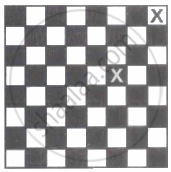
Let P denotes the probability of selecting one white and one black square from the chessboard so that they are not in the same row and also not in the same column (an example of this kind of the choice is shown in figure), then (1024)P is ______.
In a company, 15% of the employees are graduates and 85% of the employees are non-graduates. As per the annual report of the company, 80% of the graduate employees and 10% of the non-graduate employees are in the Administrative positions. Find the probability that an employee selected at random from those working in administrative positions will be a graduate.
Which expression gives Bayes' Theorem for \[P(B_i\mid A)\]?
