Advertisements
Advertisements
Question
If l, m, n are three lines such that l || m and n ⊥ l, prove that n ⊥ m.
Advertisements
Solution
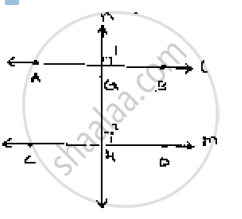
Given l || , m ,n perpendicular l
To prove: n ⊥ m
Since l || m and n intersects them at G and H respectively
∴`∠`1= `∠`2 [Corresponding angles]
But, U = 90° [n ⊥ l ]
⇒ `∠`2 = 90°
Hence n perpendicular m
APPEARS IN
RELATED QUESTIONS
How many pairs of adjacent angles are formed when two lines intersect in a point?
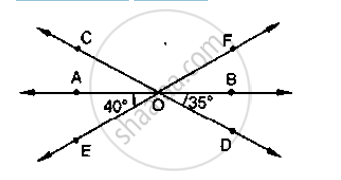
In the below fig, lines AB, CD and EF intersect at O. Find the measures of ∠AOC, ∠COF,
∠DOE and ∠BOF.
Two straight line AB and CD intersect one another at the point O. If ∠AOC + ∠COB + ∠BOD = 274°, then ∠AOD =
Given ∠POR = 3x and ∠QOR = 2x + 10°. If POQ is a straight line, then the value of x is
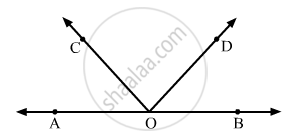
In the given figure, AOB is a straight line. If ∠AOC + ∠BOD = 85°, then ∠COD =
Two lines AB and CD intersect at O. If ∠AOC + ∠COB + ∠BOD = 270°, then ∠AOC =
Mention two real life situations where we use parallel lines
Which phrase correctly describes the distance between two parallel lines?
Which symbolic notation correctly represents the statement 'Line m is parallel to Line n?'
In the example of a 'Zebra crossing,' what feature specifically exemplifies the constant distance property of parallel lines?
