Advertisements
Advertisements
Question
If a fresh egg is put into a beaker filled with water, it sinks. On dissolving a lot of salt in the water, the egg begins to rise and then floats. Why ?
Advertisements
Solution
When a large amount of salt is dissolved in water, the density of salt solution becomes higher than pure water. It is because of its higher density, the salt solution exerts a greater upward buoyant force on the egg, making it rise and then float.
APPEARS IN
RELATED QUESTIONS
A body sinks in a liquid A but floats in a liquid B. The density of liquid A is ....... than the density of liquid B.
The density of aluminium is 2.7 g cm-3 and that of brass 8.4 g cm’3. The correct statement is
Distinguish between density and relative density.
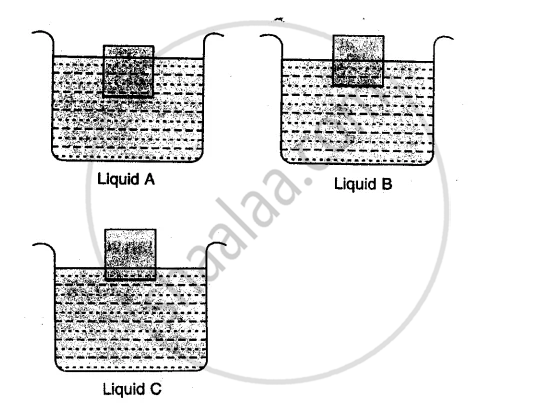
The diagram given below show a body floating in three different liquids. A, B and C at different levels.
(a) In which liquid does the body experience the greatest buoyant force?
(b) Which liquid has the least density?
(c) Which liquid has the highest density?
A block of iron of mass 7.5 kg and of dimensions 12 cm × 8 cm × 10 cm is kept on a table top on its base of side 12 cm × 8 cm.
Calculate:
- Thrust and
- Pressure exerted on the table top
Take 1 kgf = 10 N.
Define upthrust and state its S.I. unit.
Why is a force needed to keep a block of wood inside water?
Select the correct option.
The unit Nm2 is the unit of
In a fluid, buoyant force exists because the pressure at the ______ of an object is greater than the pressure at the top.
What do you understand by the term “Buoyancy”.
