Advertisements
Advertisements
Question
If an electron is brought towards another electron, the electric potential energy of the system ______.
Options
decreases
increases
Becomes zero
Remains same
Advertisements
Solution
If an electron is brought towards another electron, the electric potential energy of the system increases.
Explanation:
When an electron is brought closer to another electron, the system's electric potential energy increases because both electrons have negative charges and repel each other. Work must be done to overcome this repulsion, which increases the potential energy of the system.
RELATED QUESTIONS
A charge 6 µC is placed at the origin and another charge - 5 µC is placed on the y-axis at A = (0, 6.0 m).

(a) Calculate the net electric potential at P = (8.0 m, 0).
(b) Calculate the work done in bringing a proton from infinity to point P. What is the significance of the negative sign?
One hundred and twenty five small liquid drops, each carrying a charge of 0.5 µC and of diameter 0.1 m form a bigger drop. Calculate the potential at the surface of the bigger drop.
Which physical quantity has its unit as J/C? Is it a scalar or vector?
Find the electric potential at the surface of an atomic nucleus (Z = 50) of radius 9 × 10-13 cm.
Three-point charges +q, +2q and Q are placed at the three vertices of an equilateral triangle. Find the value of charge Q (in terms of q), so that the electric potential energy of the system is zero.
Obtain an expression for the potential energy of a dipole in an external field.
Derive an expression for the electric potential due to an electric dipole.
An AC circuit contains resistance of 12Q and inductive reactance 5Q. The phase angle between current and potential difference will be ______.
In a certain region of space with volume 0.2 m3 , the electric potential is found to be 5V throughout. The magnitude of electric field in this region is: ____________.
The electric potential V at any point O (x, y, z all in metres) in space is given by V = 4x2 volt. The electric field at the point (1 m, 0, 2m) in volt/metre is ____________.
Two parallel plates separated by a distance 'd' are kept at potential difference 'V' volt. A charge 'q' of mass 'm' enters in parallel plates with some velocity. The acceleration of the charged particle will be ______
A capacitor C1 = 4µF is connected is series with another capacitor C2 = 1µF. The combination is connected across d.c. source of 200 V. The ratio of potential across C2 to that across C1 is ______.
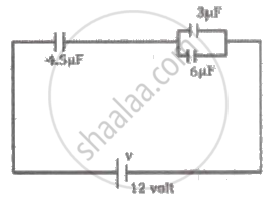
In the circuit shown, the potential difference across the 4.5 µF capacitor is ______.
Potential energy as a function of r is given by U = `"A"/"r"^10-"B"/"r"^5`, where r is the interatomic distance, A and B are positive constants. The equilibrium distance between the two atoms will be ______.
1 Weber/second is equal to ______.
Derive the relation between electric intensity and electric potential.
The potential difference (VA - VB) between the points A and B in the given figure is______.
Three point charges + Q + 2Q and q are placed at the vertices of an equilateral triangle. The value of charge q in terms of Q so that electrical potential energy of the system is zero, is given by ______.
A conducting sphere of radius 'R' is given a charge 'Q' uniformly. The electric field and the electric potential at the centre of the sphere are respectively [ε0 = permittivity of free space] ______.
A hollow charged metal sphere has a radius ‘r’. If the potential difference between its surface and a point at a distance ‘3r’ from the centre is ‘v’, then the electric field intensity at a distance ‘3r’ is ______.
