Advertisements
Advertisements
Question
If a, b, c, d are in continued proportion, prove that: `((a - b)/c + (a - c)/b)^2 - ((d - b)/c + (d - c)/b)^2 = (a - d)^2 (1/c^2 - 1/b^2)`.
Advertisements
Solution
a, b, c, d are in continued proportion
∴ `a/b = b/c = c/d` = k(say)
∴ c = dk, b = dk2, a = bk = dk2. k = dk3
L.H.S.
= `((a - b)/c + (a - c)/b)^2 - ((d - b)/c + (d - c)/b)^2`
= `((dk^3 - dk^2)/(dk) + (dk^3 - dk)/(dk^2))^2 - ((d - dk^2)/(dk) + (d - dk)/(dk^2))^2`
= `((dk^2(k - 1))/(dk) + (dk(k^2 - 1))/(dk^2))^2 - ((d(1 - k^2))/(dk) + (d( 1 - k^2))/(dk^2))^2`
= `((k(k - 1) + (k^2 - 1))/k)^2 - ((1 - k^2)/k + (1 - k)/k^2)^2`
= `((k^2(k - 1) + (k^2 - 1))/k)^2 - ((k (1- k^2) + 1 - k)/k^2)^2`
= `((k^3 - 1)^2)/k^2 - (-k^3 + 1)^2/k^4`
= `(k^3 - 1)^2/k^2 - (1 - k^3)^2/k^4`
= `((k^3 - 1)/k^2)^2 ((1 - 1)/k^2)`
= `((k^3 - 1)^2(k^2 - 1))/k^4`
= `((k^3 - 1)^2(k^2 - 1))/k^4`
R.H.S.
= `(a - d)^2(1 / c^2 - 1/b^2)`
= `(dk^3 - d)^2(1 / (d^2k^2) - (1)/(d^2k^4))`
= `d^2(k^3 - 1)^2((k^2 - 1)/(d^2k^4))`
= `((k^3 - 1)^2(k^2 - 1))/k^4`
∴ L.H.S. = R.H.S.
RELATED QUESTIONS
Given four quantities a, b, c and d are in proportion. Show that: (a – c)b2 : (b – d)cd = (a2 – b2 – ab) : (c2 – d2 – cd)
If a, b and c are in continued proportion, prove that `(a^2 + b^2 + c^2)/(a + b + c)^2 = (a - b + c)/(a + b + c)`
If `1/12` , x and `1/75` are in continued proportion , find x.
What least number must be added to each of the numbers 5, 11, 19 and 37, so that they are in proportion?
The 1st, 3rd, and 4th terms of a proportion are 12, 8, and 14 respectively. Find the 2nd term.
In covering 111 km, a car consumes 6 L of petrol. How many kilometers will it go to 10 L of petrol?
If a, b, c are in continued proportion, prove that: a : c = (a2 + b2) : (b2 + c2)
10 books is to 15 books as 3 books is to 15 books
Determine if the following are in proportion.
32, 48, 70, 210
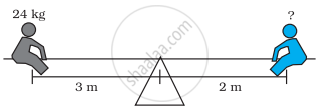
Unequal masses will not balance on a fulcrum if they are at equal distance from it; one side will go up and the other side will go down.
Unequal masses will balance when the following proportion is true:
`("mass"1)/("length"2) = ("mass"2)/("length"1)`

Two children can be balanced on a seesaw when
`("mass"1)/("length"2) = ("mass"2)/("length"1)`. The child on the left and child on the right are balanced. What is the mass of the child on the right?