Advertisements
Advertisements
Question
If q is the mean proportional between p and r, prove that: p3 – 3q2 + r2 = `q^4(1/p^2 - 3/q^2 + 1/r^2)`
Advertisements
Solution
q is mean proportional between p and r
q² = pr
L.H.S. = p2 – 3q2 + r2 = p2 – 3pr + r2
R.H.S. = `q^4(1/p^2 - 3/q^2 + 1/r^2)`
= `(q^2)^2(1/p^2 - 3/q^2 + 1/r^2)`
= `(pr)^2(1/p^2 - 3/q^2 + 1/r^2)`
= `(pr)^2(1/p^2 - 3/"pr" + 1/r^2)`
= `p^2r^2((r^2 - 3pr + p^2)/(p^2r^2))`
= r2 - 3pr + p2
∴ L.H.S. = R.H.S.
Hence proved.
APPEARS IN
RELATED QUESTIONS
What least number must be added to each of the numbers 6, 15, 20 and 43 to make them proportional?
Find the third proportional to a – b and a2 – b2
If a, b, c are in continued proportion and a(b - c) = 2b, prove that `a - c = (2(a + b))/a`
If `a/b = c/d` prove that each of the given ratios is equal to
`(5a + 4c)/(5b + 4d)`
If u, v, w, and x are in continued proportion, then prove that (2u+3x) : (3u+4x) : : (2u3+3v3) : (3u3+4v3)
Show that the following numbers are in continued proportion:
48, 60, 75
Sleeping time of a python in a 24 hour clock is represented by the shaded portion in the following figure.

The ratio of sleeping time to awaking time is ______.
Write True (T) or False (F) against the following statement:
21 : 6 : : 35 : 10
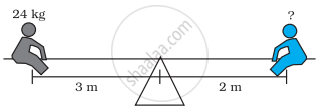
Unequal masses will not balance on a fulcrum if they are at equal distance from it; one side will go up and the other side will go down.
Unequal masses will balance when the following proportion is true:
`("mass"1)/("length"2) = ("mass"2)/("length"1)`

Two children can be balanced on a seesaw when
`("mass"1)/("length"2) = ("mass"2)/("length"1)`. The child on the left and child on the right are balanced. What is the mass of the child on the right?
What number must be added to each of the numbers 4, 6, 8, 11 in order to get the four numbers in proportion?
