Advertisements
Advertisements
Question
If  = 2x + 3,
 = `3/2x + 7` and
 = x – 3 then find the value of:
2 +
 –

Advertisements
Solution
Given, = 2x + 3, = `3/2x + 7` and = x – 3
2 + – = `2 xx (2 xx 6 + 3) + (3/2 xx 3 + 7) - (1 - 3)`
= `2 xx (12 + 3) + (9/2 + 7) - (-2)`
= `2 xx 15 + (23/2) + 2`
= `30 + 2 + 23/2`
= `32 + 23/2`
= `(32 xx 2 + 23)/2`
= `(64 + 23)/2`
= `87/2`
APPEARS IN
RELATED QUESTIONS
If 9 is added to a certain number, the result is 36. Find the number.
Find a number which when multiplied by 5 is increased by 80.
Find two numbers such that one of them exceeds the other by 18 and their sum is 92.
A man is thrice as old as his son. Five years ago the man was four times as old as his son. Find their present ages.
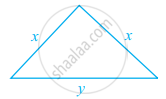
The perimeter of the triangle shown in the following figure is ______.
The two digit number whose ten’s digit is ‘t’ and units’s digit is ‘u’ is ______.
If m is a whole number, then 2 m denotes a multiple of 2.
If x is a negative integer, – x is a positive integer.
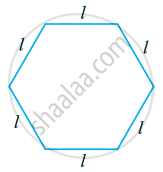
The side of a regular hexagon is denoted by l. Express the perimeter of the hexagon using l.
(Hint: A regular hexagon has all its six sides equal in length.)
A cube is a three-dimensional figure as shown in the given figure. It has six faces and all of them are identical squares. The length of an edge of the cube is given by l. Find the formula for the total length of the edges of a cube.

The expression for the number of diagonals that we can make from one vertex of a n sided polygon is ______.
The speed of car is 55 km/hrs. The distance covered in y hours is ______.
In a rectangular plot, 5 square flower beds of side (x + 2) metres each have been laid (see the figure). Find the total cost of fencing the flower beds at the cost of ₹ 50 per 100 metres:

The sum of first n natural numbers is given by `1/2n^2 + 1/2n`. Find the sum of first 5 natural numbers.
The sum of first n natural numbers is given by `1/2n^2 + 1/2n`. Find the sum of first 11 natural numbers.
The sum of squares of first n natural numbers is given by `1/6n(n + 1)(2n + 1)` or `1/6(2n^3 + 3n^2 + n)`. Find the sum of squares of the first 10 natural numbers.
The sum of the multiplication table of natural number ‘n’ is given by 55 × n. Find the sum of table of 19.
If  = `3/4x - 2` and
 = x + 6, then find the value of:
2 – `3/2`

