Advertisements
Advertisements
Question
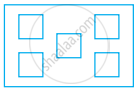
In a rectangular plot, 5 square flower beds of side (x + 2) metres each have been laid (see the figure). Find the total cost of fencing the flower beds at the cost of ₹ 50 per 100 metres:
Advertisements
Solution
Given, side of one square flower bed = (x + 2) m
∴ Perimeter of one square flower bed = 4(Side) = 4(x + 2) m
Now, total perimeter of 5 such square flower beds = 5 × Perimeter of one square
= 5 × 4(x + 2)
= 20(x + 2) m
∵ Cost of fencing of 100 m = ₹ 50
∴ Cost of 1 m = ₹ `50/100`
∴ Cost of 20(x + 2) m = `50/100 xx 20(x + 2)`
= 10(x + 2)
= ₹ (10x + 20)
APPEARS IN
RELATED QUESTIONS
Use the given algebraic expression to complete the table of number patterns.
| S. No |
Expression |
Terms | |||||||||
| 1st | 2nd | 3rd | 4th | 5th | ... | 10th | ... | 100th | ... | ||
| 1 | 2n - 1 | 1 | 3 | 5 | 7 | 9 | - | 19 | - | - | - |
| 2 | 3n + 2 | 5 | 8 | 11 | 14 | - | - | - | - | - | - |
| 3 | 4n + 1 | 5 | 9 | 13 | 17 | - | - | - | - | - | - |
| 4 | 7n + 20 | 27 | 34 | 41 | 48 | - | - | - | - | - | - |
| 5 | n2 + 1 | 2 | 5 | 10 | 17 | - | - | - | - | 10001 | - |
Write down the following in the product form: x2y4
Write down the following in the product form: 6y5
If 9 is added to a certain number, the result is 36. Find the number.
Find two numbers such that one of them is five times the other and their difference is 132.
Deepak is twice as old as his brother Vikas. If the difference between their ages is 11 years, find their present ages.
Mrs. Goel is 27 years older than her daughter Rekha. After 8 years she will be twice as old as Rekha. Find their present ages.
The perimeter of the triangle shown in the following figure is ______.
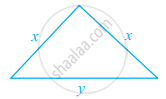
If I spend f rupees from 100 rupees, the money left with me is ______ rupees.
The additive inverse of an integer x is 2x.
The side of an equilateral triangle is shown by l. Express the perimeter of the equilateral triangle using l.
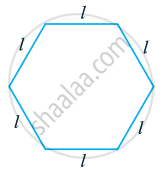
The side of a regular hexagon is denoted by l. Express the perimeter of the hexagon using l.
(Hint: A regular hexagon has all its six sides equal in length.)
A cube is a three-dimensional figure as shown in the given figure. It has six faces and all of them are identical squares. The length of an edge of the cube is given by l. Find the formula for the total length of the edges of a cube.

The length of a side of square is given as 2x + 3. Which expression represents the perimeter of the square?
Find the perimeter of the figure given below:
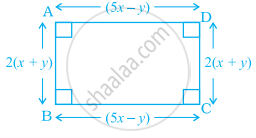
The sum of first n natural numbers is given by `1/2n^2 + 1/2n`. Find the sum of natural numbers from 11 to 30.
The sum of the multiplication table of natural number ‘n’ is given by 55 × n. Find the sum of table of 19.
If  = `3/4x - 2` and
  = x + 6, then find the value of:
2 – `3/2`
Write an expression for the sum of 1 and twice a number n. If you let n be any odd number, will the result always be an odd number?
