Advertisements
Advertisements
Question
How many lines of symmetry for the following figure
Advertisements
Solution

APPEARS IN
RELATED QUESTIONS
Copy the figure with punched holes and find the axes of symmetry for the following:
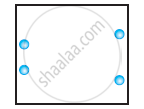
Copy the figure with punched holes and find the axes of symmetry for the following:
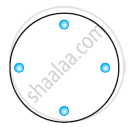
Copy the figure with punched holes and find the axes of symmetry for the following:
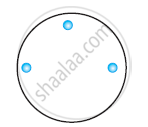
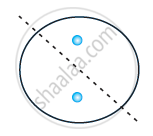
Given the line of symmetry, find the other hole:
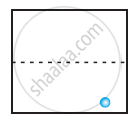
Given the line(s) of symmetry, find the other hole(s):
Copy the diagram and complete the given shape to be symmetric about the mirror line(s):
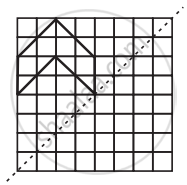
Copy the diagram and complete the given shape to be symmetric about the mirror line(s):
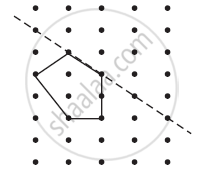
State the number of lines of symmetry for a parallelogram figure.
State the number of lines of symmetry for a circle figure.
What letters of the English alphabet have reflectional symmetry (i.e., symmetry related to mirror reflection) about a vertical mirror.
What letters of the English alphabet have reflectional symmetry (i.e., symmetry related to mirror reflection) about both horizontal and vertical mirrors.
Complete the other half of the following figure such that the dotted line is the line of symmetry.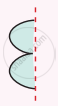
Complete the other half of the following figure such that the dotted line is the line of symmetry.
Draw the line of symmetry in the following figure.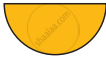
Draw the lines of symmetry in the following figure.
 ___________ ___________
Draw what the following shapes would look like on a `1/4` turn and half a turn.
| On `1/4` turn | On half turn | |
a)  |
||
b)  |
||
c)  |
||
d)  |
- Which of the above shapes do not look the same on the `1/4` turn?
- Which shapes do not look the same on `1/2` a turn?
A regular hexagon has six lines of symmetry.
The number of lines of symmetry of a regular polygon is equal to the vertices of the polygon.
