Advertisements
Advertisements
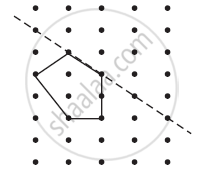
Question
Draw the line of symmetry in the following figure.
Advertisements
Solution

APPEARS IN
RELATED QUESTIONS
Copy the figure with punched holes and find the axes of symmetry for the following:
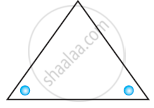
Copy the figure with punched holes and find the axes of symmetry for the following:

The following figures have more than one line of symmetry. Such figures are said to have multiple lines of symmetry.
 |
 |
 |
| (a) | (b) | (c) |
Identify multiple lines of symmetry, if any, in the following figure:
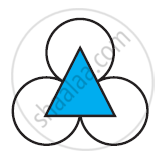
The following figures have more than one line of symmetry. Such figures are said to have multiple lines of symmetry.
|
|
|
| (a) | (b) | (c) |
Identify multiple lines of symmetry, if any, in the following figure.
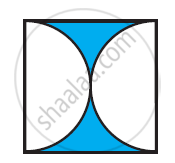
Copy the diagram and complete the given shape to be symmetric about the mirror line(s):
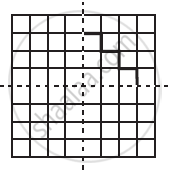
Copy the diagram and complete the given shape to be symmetric about the mirror line(s):
State the number of lines of symmetry for an equilateral triangle figure.
State the number of lines of symmetry for an isosceles triangle figure.
State the number of lines of symmetry for a rhombus figure.
State the number of lines of symmetry for a circle figure.
Complete the other half of the following figure such that the dotted line is the line of symmetry.
Draw the line of symmetry in the following figure.
Draw the line of symmetry in the following figure.
How many lines of symmetry for the following figure
How many lines of symmetry for the following figure
A regular hexagon has six lines of symmetry.
The number of lines of symmetry of a regular polygon is equal to the vertices of the polygon.
Draw an isosceles triangle with each of equal sides of length 3 cm and the angle between them as 45°.
