Advertisements
Advertisements
Question
How does initiation of the translation process occur in prokaryotes? Explain.
Advertisements
Solution
For initiation, the ribosome binds to the mRNA at the start codon (AUG) that is recognised only by the initiator tRNA. The ribosome proceeds to the elongation phase of protein synthesis. During this stage, complexes composed of an amino acid linked to tRNA, sequentially bind to the appropriate codon in mRNA by forming complementary base pairs with the tRNA anticodon. The ribosome moves from codon to codon along the mRNA. Amino acids are added one by one, translated into Polypeptide sequences dictated by DNA and represented by mRNA. At the end, a release factor binds to the stop codon, terminating translation and releasing the complete polypeptide from the ribosome.
APPEARS IN
RELATED QUESTIONS
The process of translation is ______.
The translation termination triplet is ______.
UTRs are the untranslated regions present on ______.
Which of the following statements is correct regarding ribosomes?
Which cellular process is shown below?
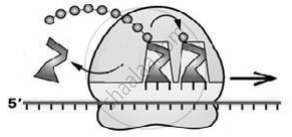
The process of translation is ______.
Where are the untranslated regions located on mRNA and why?
What is a triplet codon?
Which of the following is the start codon in translation?
Which ribosomal site receives the incoming aminoacyl-tRNA during translation?
