Advertisements
Advertisements
Question
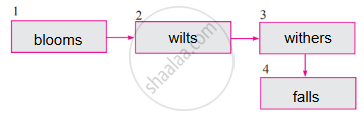
Go through the lesson again and complete the flow-chart that highlights the life of a ‘hibiscus’ flower.
Advertisements
Solution
APPEARS IN
RELATED QUESTIONS
What things in nature teach us the following:
Problems are not permanent.
What things in nature teach us the following:
Make the best use of time and opportunity.
Read the question from the lesson. What do they imply?
Are you listening?
Read the question from the lesson. What do they imply?
What if we too are consistent, organised, focused...?
The writer has very positively described the different things in nature. Discuss with your partner the special features of each one of them. Add on the list.
| Part of Nature | Special feature | Value learnt |
| 1. Rainbow | ||
| 2. Caterpillar | ||
| 3. | ||
| 4. | ||
| 5. | ||
| 6. | ||
| 7. |
Think and answer in your own words.
‘An oyster turns a grain of sand into a pearl.’ What can we learn from this example?
Think and answer in your own words.
Why does the writer begin by quoting the lines from William Blake’s poem (Auguries of Innocence)?
Look at the following thing. Discuss with your friend, what you learn from them.
A bee ............
The writer explains the contrasting features of ‘water’ and ‘rock’ in the text. Write all the features of both water and rock in the given table.
| Water | Rock |
| 1. | 1. |
| 2. | 2. |
| 3. | 3. |
| 4. | 4. |
Impossible itself says ‘I M possible’. Do you agree? Justify your answer by citing some examples from the text and some that you have experienced or heard from someone.
