Advertisements
Advertisements
Question
Given below is an example of a certain structure and its special functional activity:
chloroplasts and photosynthesis
In a similar way, write the functional activity against the following:
Xylem and ______
Advertisements
Solution
Xylem and conduction of water and mineral salts
APPEARS IN
RELATED QUESTIONS
Describe an experiment to show that the plant loses water through its leaves.
Given below is an apparatus which has setup to investigate a physiological process in plants. The setup was placed in bright sunlight. Answer the questions that follow: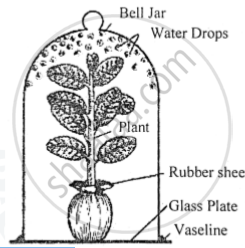
Draw a neat, labelled diagram of a stomatal apparatus.
The cause of wilting is more because of ______.
Choose the correct answer:
In herbaceous plants, following percentage of absorbed water comes out __________
Give Reasons for the following:
Young plants wilt on a hot sunny day.
The figure given below represents an experimental setup with a weighing machine to demonstrate a particular process in plants. The experimental set-up was placed in bright sunlight. Study the diagram and answer the following questions:
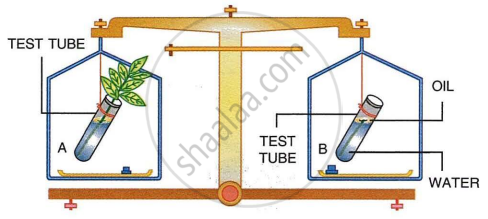
- Name the process intended for the study.
- Define the above mentioned process.
- When the weight of the test tubes (A and B) is taken before and after the experiment, what is observed? Give reasons to justify your observations in A & B.
- What is the purpose of keeping the test tube B in the experimental set-up?
- What is the purpose of putting oil in the test tube?
Complete the following sentence with appropriate word:
Transpiration is the loss of water__________________from the leaves of the plant.
Write the functional activity of the following structure:
Hydathodes
Column ‘II’ is a list of items related to ideas in Column ‘I’. Match the term in Column ‘II’ with a suitable idea given in Column ‘I’.
| Column I | Column II |
| (i) Transpiration | (a) Cacti plants |
| (ii) Movement of water | (b) Stomata |
| (iii) Guttation | (c) Maize plant |
| (iv) Low rate of transpiration | (d)Xylem |
| (v) The high rate of transpiration | (e) Hydathodes |
