Advertisements
Advertisements
Question
Given below is a diagram representing a stage during mitotic cell division. Study it carefully and answer the question that follow.
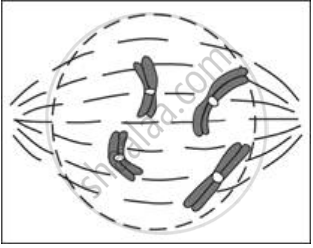
How will you differentiate between mitosis and meiosis on the basis of the chromosome number in the daughter cells?
Advertisements
Solution
Difference between mitosis and meiosis based on the chromosome number in daughter cells:
|
Mitosis |
Meiosis |
|
Chromosome number remains the same as that of parent cells. |
Daughter cells receive only half the number of chromosomes from parent cells. |
RELATED QUESTIONS
Given below is a diagram representing a stage during the mitotic cell division. Study [5] thediagram and answer the following questions: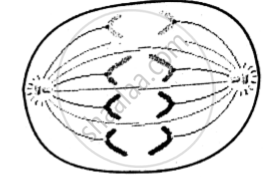
Name of the nitrogenous bases.
Choose the correct answer:
Somatic cells divide by ___________
Choose the correct answer:
Chromosomes appear at equator in _____________
Given below is a diagram representing a stage during mitotic cell division. Study it carefully and answer the question that follow.
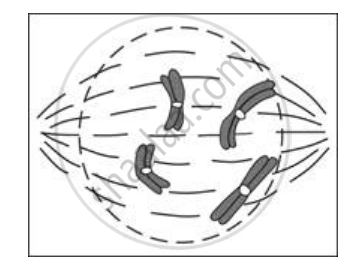
Is it a plant cell or an animal cell? Give a reason to support your answer.
Given below is a diagram representing a stage during mitotic cell division. Study it carefully and answer the questions that follow.
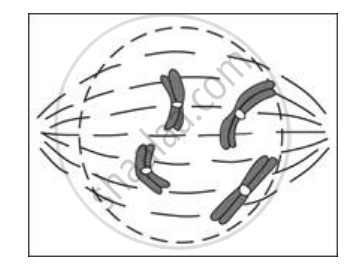
Identify the stage shown.
What is cytokinesis?
Explain the significance of mitosis.
Give Technical Terms
The division which brings about vegetative growth.
Complete the following sentence with appropriate word :
The type of cell division that occurs in the apical meristem of plants is ______.
The growth of multicellular organisms is due to
