Advertisements
Advertisements
Question
Given below are the end products of different reactions involving glucose.

Write the reaction number in front of the following:
(i) Anaerobic reaction =
(ii) Reaction in the human muscles =
(iii) Aerobic respiration =
(iv) Reaction in the plant cells =
(v) Reaction in the liver
Advertisements
Solution
(1) Anaerobic reaction = 5
(2) Reaction in the human muscles = 4
(3) Aerobic respiration = 3
(4) Reaction in the plant cells = 1
(5) Reaction in the liver = 2
APPEARS IN
RELATED QUESTIONS
Name two animals which breathe through gills.
What is the name of tiny air-sacs at the end of smallest bronchioles in the lungs?
State whether the following statement is true or false:
Energy can be produced in cells without oxygen.
Explain how, it would benefit deep sea divers if humans also had gills.
During respiration, the exchange of gases takes place in ______.
During the deficiency of oxygen in tissues of human beings, pyruvic acid is converted into lactic acid in ______.
Which of the following is most likely to have a much higher breathing rate?
With which human organ system (or human systems) is the alveoli associated?
Answer the following in short.
Define respiration.
Name the body structure concerned with the given functional activity:
Transports oxygen to the body cells.
State one function of the following:
Diaphragm
Give suitable explanation for the following :
Why does a person feel breathlessness at higher altitudes?
Given below is an overall chemical reaction of a certain process:
C6H12O6 →LacticAcid+2ATP+Heat energy
Name the process.
What percent of oxygen is transported in a dissolved state by the plasma?
Name the substances whose build-up in the muscles during vigorous physical exercise may cause cramps?
Sometimes when we do heavy exercise, anaerobic respiration takes place in our muscle cells. What is produced during this process?
On a very cold morning, Boojho and Paheli were talking with each other as they walked down to their school. They observed that the air coming out of their mouth looked like smoke. They were amused and wondered how it happened. Help them find the answer.
Observe the figure carefully and answer the following questions.
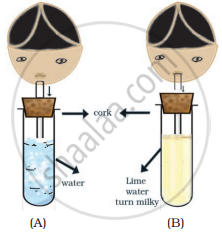
- Which process is being tested in the activity?
- What is the result of the activity? Give reasons.
Visit a local doctor. Learn about the harmful effects of smoking. You can also collect material on this topic from other sources. You can seek help of your teacher or parents. Find out the percentage of people of your area who smoke. If you have a smoker in your family, confront him with the material that you have collected.
