Advertisements
Advertisements
Question
Give three points to differentiate between saturated and unsaturated
hydrocarbons.
Advertisements
Solution
| S.No. | Saturated organic comnound | Unsaturated organic comnound |
| 1. | All the four valencies of each carbon atom are satisfied by forming single covalent bonds with carbon and with hydronen atoms. | The valencies of at least two carbon atoms are not fully satisfied by the hydrogen atoms. |
| 2. | Carbon atoms are joined only by a single covalent bond | Carbon atoms are joined by double covalent bonds or by trinle covalent bonds. |
| 3. | Less reactive | More reactive |
APPEARS IN
RELATED QUESTIONS
What is a homologous series?
Write the next homologue of the following: C2H4
Write the molecular formula of the 2nd and 3rd member of the homologous series where the first member is ethyne.
Ethene and ethyne are examples of ______ hydrocarbons.
By how many carbon atoms and hydrogen atoms do any two adjacent homologues differ?
Give the structure of the second member of the alcohol group.
Define homologous series of organic compounds. List its two characteristics. Write the name and formula of the first member of the series of alkenes.
The general molecular formula for the homologous series of alkynes is _______.
Observe the structural formula and answer the following questions.
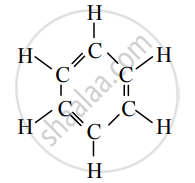
- Write the name of the given hydrocarbon.
- The given hydrocarbon is included in which type of hydrocarbon?
- What is the kind of compounds with the above characteristic structure called?
