Advertisements
Advertisements
Question
Give reasons for the polarity of C – X bond in haloalkane.
Advertisements
Solution
- Carbon halogen bond is a polar bond as halogens are more electronegative than carbon. The carbon atom exhibits a partial positive charge (δ+) and halogen atom a partial negative charge (δ–).
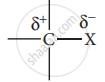
- The C -X bond is formed by the overlap of sp3 orbital of a carbon atom with the half-filled p- orbital of the halogen atom. The atomic size of halogen increases from fluorine to iodine, which increases the C – X bond length. Larger the size, greater is the bond length, and the weaker is the bond formed. The bond strength of C – X decreases from C – F to C – I in CH3X.
APPEARS IN
RELATED QUESTIONS
Of the following compounds, which has the highest boiling point?
With respect to the position of – Cl in the compound CH3 – CH = CH – CH2 – Cl, it is classified as ______.
The most easily hydrolysed molecule under SN1 condition is ______.
Which one of the following is most reactive towards nucleophilic substitution reaction?
In an experiment ethyliodide in ether is allowed to stand over magnesium pieces. Magnesium dissolves and product is formed
- Name the product and write the equation for the reaction.
- Why all the reagents used in the reaction should be dry? Explain.
- How is acetone prepared from the product obtained in the experiment.
Predict the product when Bromo ethane is treated with the following.
KNO2
Predict the products when Bromo ethane is treated with the following.
AgNO2
Write a short note on Dows Process.
Complete the following reaction.
\[\ce{CH3 - CH2 - Br + NaSH ->[alcohol][H2O]}\]
The simplest alkene (A) reacts with HCl to form a compound (B). Compound (B) reacts with ammonia to form compound (C) of molecular formula C2H7N. Compound (C) undergoes carbylamine test. Identify (A),
(B) and (C).
