Advertisements
Advertisements
प्रश्न
Give reasons for the polarity of C – X bond in haloalkane.
Advertisements
उत्तर
- Carbon halogen bond is a polar bond as halogens are more electronegative than carbon. The carbon atom exhibits a partial positive charge (δ+) and halogen atom a partial negative charge (δ–).
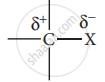
- The C -X bond is formed by the overlap of sp3 orbital of a carbon atom with the half-filled p- orbital of the halogen atom. The atomic size of halogen increases from fluorine to iodine, which increases the C – X bond length. Larger the size, greater is the bond length, and the weaker is the bond formed. The bond strength of C – X decreases from C – F to C – I in CH3X.
APPEARS IN
संबंधित प्रश्न
Of the following compounds, which has the highest boiling point?
Match the compounds given in Column I with suitable items given in Column II.
| Column I (Compound) | Column II (Uses) |
||
| A | Iodoform | 1 | Fire extinguisher |
| B | Carbon tetra chloride | 2 | Insecticide |
| C | CFC | 3 | Antiseptic |
| D | DDT | 4 | Refrigerants |
Which one of the following is most reactive towards nucleophilic substitution reaction?
Mention any three methods of preparation of haloalkanes from alcohols.
Compare SN1 and SN2 reaction mechanisms.
t – butyl chloride reacts with aqueous KOH by SN1 mechanism while n – butyl chloride reacts with SN2 mechanism.
In an experiment ethyliodide in ether is allowed to stand over magnesium pieces. Magnesium dissolves and product is formed
- Name the product and write the equation for the reaction.
- Why all the reagents used in the reaction should be dry? Explain.
- How is acetone prepared from the product obtained in the experiment.
Write a short note on Dows Process.
Complete the following reaction.
\[\ce{CH3 - CH = CH2 + HBr ->[Peroxide]}\]
The simplest alkene (A) reacts with HCl to form a compound (B). Compound (B) reacts with ammonia to form compound (C) of molecular formula C2H7N. Compound (C) undergoes carbylamine test. Identify (A),
(B) and (C).
