Advertisements
Advertisements
Question
Give its
(i) mathematical expression
(ii) graphical representation and
(iii) significance.
Advertisements
Solution
(i) mathematical expression
suppose a gas occupies volume V1 when its pressure is P1; then
`"V"_1 ∝ 1/"P"_1 "or" "V"_1 = "k"/"P"_1`
`"P"_1"V"_1 = "k" = "constant"`
If V2 is the volume ocuupied when the pressure is P2 at the same temperature, the
`"V"_2 ∝ 1/"P"_2 "or" "V"_2 = "k"/"P"_2`
`"P"_2"V"_2 = "k" = "constant"`
`"P"_1"V"_1 = "P"_2"V"_2 = "k"` at constant temperature.
This is called Boyle's law equation.
(ii) graphical representation
The law can be verified by plotting a graph
(a) V vs `1/p` (b) V vs P (c) PV vs P
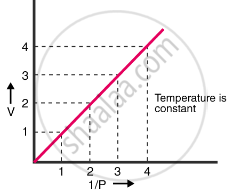
(a) V vs `1/p`: a straight line passing through the origin is obtained
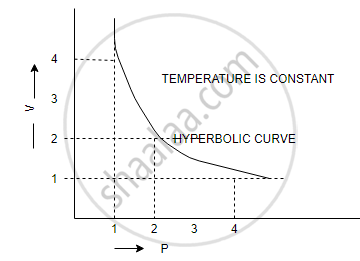
(b) V vs P: a hyperbolic curve in the first quadrant is obtained
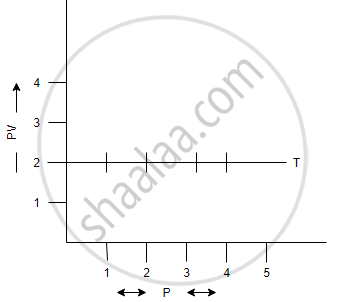
(c) PV vs P: a straight line is obtained parallel to the pressure axis.
(iii) Significance
On increasing pressure, volume decreases. The gas becomes denser. Thus at a constant temperature, the density of a gas is directly proportional to its pressure.
Atmospheric pressure is low at high altitudes, so air is less dense. Hence, a lesser quantity of oxygen is available for breathing. This is the reason why mountaineers have to carry oxygen cylinders with them.
APPEARS IN
RELATED QUESTIONS
Give reasons for the following:
It is necessary to specify the pressure and temperature of gas while stating its volume.
Choose the correct answer:
If the pressure is doubled for a fixed mass of a gas, its volume will become
A steel cylinder of internal volume 20 litres is filled with hydrogen at 29 atmospheric pressure. If hydrogen is used to fill a balloon at 1.25 atmospheric pressure at the same temperature, what volume will the gas occupy?
Calculate the volume of dry air at STP that occupies 28 cm3 at 14°C and 750 mmHg pressure when saturated with water vapour. The vapour pressure of water at 14°C is 12 mmHg.
22.4 litres of gas weighs 70 g at STP. Calculate the weight of the gas if it occupies a volume of 20 litres at 27°C and 700 mmHg of pressure.
Name or state the following:
The law which studies the relationship between pressure of a gas and the volume occupied by it at constant temperature.
Calculate the following:
Calculate the temperature at which a gas ‘A’ at 20°C having a volume, of 500 cc. will occupy a volume of 250 cc.
Assuming temperature remaining constant calculate the pressure of the gas in the following:
The pressure of a gas having volume 1500 cm3 originally occupying 750 cc. at 5 ats. pressure.
Fill in the blank with the correct word, from the words in option:
If the pressure of a fixed mass of a gas is kept constant and the temperature is increased, the volume correspondingly _______
State-the law of volume
