Advertisements
Advertisements
Question
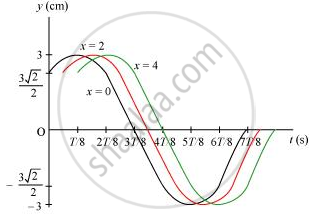
For the wave described in Exercise 15.8, plot the displacement (y) versus (t) graphs for x = 0, 2 and 4 cm. What are the shapes of these graphs? In which aspects does the oscillatory motion in travelling wave differ from one point to another: amplitude, frequency or phase?
Advertisements
Solution 1
All the waves have different phases.
The given transverse harmonic wave is:
`y (x,t)= 3.0 sin (36t + 0.018x + pi/4)` ...(i)
For x = 0, the equation reduces to:
`y (0,t) = 3.0 sin (36t + pi/4)`
Also, `omega = (2pi)/T = 36 " rad/s"^(-1)`
`:. T = pi/8 s`
Now, plotting y vs. t graphs using the different values of t, as listed in the given table.
| t(s) | 0 | T/8 | 2T/8 | 3T/8 | 4T/8 | 5T/8 | 6T/8 | 7T/8 |
| y(cm) | `(3sqrt2)/2` | 3 | `(3sqrt2)/2` | 0 | `(-3sqrt2)/2` | -3 | `(-3sqrt2)/2` | 0 |
For x = 0, x = 2, and x = 4, the phases of the three waves will get changed. This is because amplitude and frequency are invariant for any change in x. The y-t plots of the three waves are shown in the given figure.
Solution 2
The transverse harmonic wave is
`y(x,t) = 3.0 sin (36t + 0.018x + pi/4)`
for x = 0
`y(0,t) = 3 sin(36t + 0 + pi/4) = 3 sin (36t + pi/4)` ...1
Here `omega = (2pi)/T = 36 => T =(2pi)/36`
To plot a(y) versus (t) graph, different values of y corresponding to the values of t may be tabulated as under (by making use of equation 1)
| t(s) | 0 | T/8 | 2T/8 | 3T/8 | 4T/8 | 5T/8 | 6T/8 | 7T/8 | T |
| y(cm) | `(3sqrt2)/2` | 3 | `(3sqrt2)/2` | 0 | `(-3sqrt2)/2` | -3 | `(-3sqrt2)/2` | 0 | `3/sqrt2` |
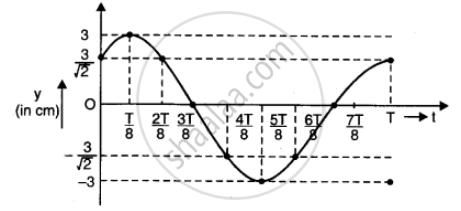
Using the values of t and y (as in the table), a graph is plotted as under The graph obtained is sinusoidal.
Similar graphs are obtained for y x = 2 cm and x = 4 cm. The (incm) oscillatory motion in the travelling wave only differs in respect of phase. Amplitude and frequency of oscillatory motion remains the same in all the cases.
APPEARS IN
RELATED QUESTIONS
A steel wire has a length of 12.0 m and a mass of 2.10 kg. What should be the tension in the wire so that speed of a transverse wave on the wire equals the speed of sound in dry air at 20 °C = 343 m s–1.
A hospital uses an ultrasonic scanner to locate tumours in a tissue. What is the wavelength of sound in the tissue in which the speed of sound is 1.7 km s–1? The operating frequency of the scanner is 4.2 MHz.
A train, standing in a station-yard, blows a whistle of frequency 400 Hz in still air. The wind starts blowing in the direction from the yard to the station with at a speed of 10 m s–1. What are the frequency, wavelength, and speed of sound for an observer standing on the station’s platform? Is the situation exactly identical to the case when the air is still and the observer runs towards the yard at a speed of 10 m s–1? The speed of sound in still air can be taken as 340 m s–1.
Choose the correct option:
Which of the following equations represents a wave travelling along Y-axis?
A sonometer wire of length l vibrates in fundamental mode when excited by a tuning fork of frequency 416. Hz. If the length is doubled keeping other things same, the string will ______.
The displacement of the particle at x = 0 of a stretched string carrying a wave in the positive x-direction is given f(t) = A sin (t/T). The wave speed is v. Write the wave equation.
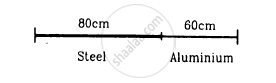
Figure shows an aluminium wire of length 60 cm joined to a steel wire of length 80 cm and stretched between two fixed supports. The tension produced is 40 N. The cross-sectional area of the steel wire is 1⋅0 mm2 and that of the aluminium wire is 3⋅0 mm2. What could be the minimum frequency of a tuning fork which can produce standing waves in the system with the joint as a node? The density of aluminium is 2⋅6 g cm−3 and that of steel is 7⋅8 g cm−3.
A 40 cm wire having a mass of 3⋅2 g is stretched between two fixed supports 40⋅05 cm apart. In its fundamental mode, the wire vibrates at 220 Hz. If the area of cross section of the wire is 1⋅0 mm2, find its Young modulus.
A 2⋅00 m-long rope, having a mass of 80 g, is fixed at one end and is tied to a light string at the other end. The tension in the string is 256 N. (a) Find the frequencies of the fundamental and the first two overtones. (b) Find the wavelength in the fundamental and the first two overtones.
The string of a guitar is 80 cm long and has a fundamental frequency of 112 Hz. If a guitarist wishes to produce a frequency of 160 Hz, where should the person press the string?
An organ pipe of length 0.4 m is open at both ends. The speed of sound in the air is 340 m/s. The fundamental frequency is ______
A bat emits an ultrasonic sound of frequency 1000 kHz in the air. If the sound meets a water surface, what is the wavelength of the the reflected sound? The speed of sound in air is 340 m s–1 and in water 1486 m s–1.
Sound waves of wavelength λ travelling in a medium with a speed of v m/s enter into another medium where its speed is 2v m/s. Wavelength of sound waves in the second medium is ______.
A string of mass 2.5 kg is under a tension of 200 N. The length of the stretched string is 20.0 m. If the transverse jerk is struck at one end of the string, the disturbance will reach the other end in ______.
At what temperatures (in °C) will the speed of sound in air be 3 times its value at O°C?
If c is r.m.s. speed of molecules in a gas and v is the speed of sound waves in the gas, show that c/v is constant and independent of temperature for all diatomic gases.
