Advertisements
Advertisements
Question
For hook-up, determine whether there is a single repeater machine that will do the same work. If so, describe or draw it.

Advertisements
Solution
Using law of exponents,
am × an = (a)m + n ...[∵ a is non-zero integer]
Hook-up machine’s work = (0.5)2 × (0.5)3 = (0.5)5 ...[∵ am × an = am + n]
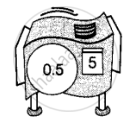
So, (×(0.5)5) machine can for the same work.
Diagram of single ×(0.5)5 machine.
APPEARS IN
RELATED QUESTIONS
The value of `(-2/3)^4` is equal to ______.
For a non-zero rational number p, p13 ÷ p8 is equal to ______.
50 = ______.
By multiplying `(5/3)^4` by ______ we get 54.
The value of `1/4^-2` is equal to 16.
Express as a power of a rational number with negative exponent.
(25 ÷ 28) × 2–7
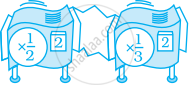
Find a single repeater machine that will do the same work as hook-up.

Find a single repeater machine that will do the same work as hook-up.
By what number should (–8)–3 be multiplied so that the product may be equal to (–6)–3?
If a = – 1, b = 2, then find the value of the following:
ab + ba
