Advertisements
Advertisements
Question
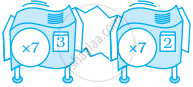
For hook-up, determine whether there is a single repeater machine that will do the same work. If so, describe or draw it.
Advertisements
Solution
Using law of exponents,
am × an = (a)m + n ...[∵ a is non-zero integer]
Hook-up machine can do the work = 73 × 72 = 75
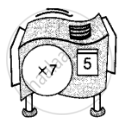
So, (x 75) single machine can do the same work.
Diagram of single × 75 machine.
APPEARS IN
RELATED QUESTIONS
Find the value of `1/(3^(-2))`.
Simplify and write the answer in the exponential form.
`1/8 xx (3)^(-3)`
On multiplying ______ by 2–5 we get 25.
`10^-2 = 1/100`
(–6)0 = –1
`a^m = 1/a^-m`
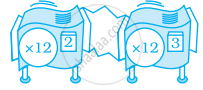
For hook-up, determine whether there is a single repeater machine that will do the same work. If so, describe or draw it.
The left column of the chart lists the lengths of input chains of gold. Repeater machines are listed across the top. The other entries are the outputs you get when you send the input chain from that row through the repeater machine from that column. Copy and complete the chart.
| Input Length | Repeater Machine | ||
| × 23 | |||
| 40 | 125 | ||
| 2 | |||
| 162 | |||
Mass of Mars is 6.42 × 1029 kg and mass of the Sun is 1.99 × 1030 kg. What is the total mass?
Simplify:
`[(1/2)^2 - (1/4)^3]^-1 xx 2^-3`
