Advertisements
Advertisements
Question
Find the quotient and remainder of the following.
(4x3 + 6x2 – 23x + 18) ÷ (x + 3)
Advertisements
Solution
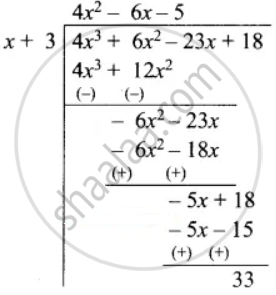
∴ The quotient = 4x2 – 6x – 5
The remainder = 33
APPEARS IN
RELATED QUESTIONS
Give examples of polynomials p(x), g(x), q(x) and r(x), which satisfy the division algorithm
deg p(x) = deg q(x)
Apply division algorithm to find the quotient q(x) and remainder r(x) on dividing f(x) by g(x) in the following:
f(x) = x3 – 6x2 + 11x – 6, g(x) = x2 + x + 1
Apply division algorithm to find the quotient q(x) and remainder r(x) on dividing f(x) by g(x) in the following:
f(x) = 4x3 + 8x + 8x2 + 7, g(x) = 2x2 – x + 1
Obtain all zeros of the polynomial f(x) = x4 − 3x3 − x2 + 9x − 6, if two of its zeros are `-sqrt3` and `sqrt3`
Find all the zeros of the polynomial x4 + x3 – 34x2 – 4x + 120, if two of its zeros are 2 and –2.
Show that every positive odd integer is of the form (4q +1) or (4q+3), where q is some integer.
Find the quotient and remainder of the following.
(−18z + 14z2 + 24z3 + 18) ÷ (3z + 4)
The sum of (x + 5) observations is (x3 + 125). Find the mean of the observations
Can x2 – 1 be the quotient on division of x6 + 2x3 + x – 1 by a polynomial in x of degree 5?
If on division of a non-zero polynomial p(x) by a polynomial g(x), the remainder is zero, what is the relation between the degrees of p(x) and g(x)?
