Advertisements
Advertisements
Question
Find the probabilities of the events given in Question 2.
Advertisements
Solution
1)
- Out of 6 possible outcomes, a prime number can be obtained in three cases. Therefore, the probability of getting a prime number = `3/6 = 1/2`
- Out of 6 possible outcomes, a prime number may not be obtained in three cases.
Therefore, the probability of getting not a prime number = `3/6 = 1/2`
2)
- Out of 6 possible outcomes, a number greater than 5 can be obtained in only 1 case.
Therefore, the probability of getting a number greater than 5 = `1/6` - Out of 6 possible outcomes, a number not greater than 5 can be obtained in 5 cases.
Therefore, the probability of getting a number not greater than 5 = `5/6`
RELATED QUESTIONS
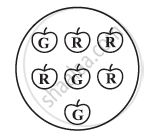
Find the probability of getting a red apple.
Numbers 1 to 10 are written on ten separate slips (one number on one slip), kept in a box and mixed well. One slip is chosen from the box without looking into it. What is the probability of.
- Getting a number 6?
- Getting a number less than 6?
- Getting a number greater than 6?
- Getting a 1-digit number?
There are 6 marbles in a box with numbers from 1 to 6 marked on each of them.
What is the probability of drawing a marble with number 2?
An urn contains 10 red and 8 white balls. One ball is drawn at random. Find the probability that the ball drawn is white.
A bag contains 4 red, 5 black and 6 white balls. A ball is drawn from the bag at random. Find the probability that the ball drawn is:
not black
When two dice are rolled:
Find the probability of getting a total less than 5?
Rohit collected the data regarding weights of students of his class and prepared the following table:
| Weight (in kg) | 44 – 47 | 48 – 51 | 52 – 55 | 56 – 60 |
| Number of Students | 3 | 5 | 25 | 7 |
A student is to be selected randomly from his class for some competition. The probability of selection of the student is highest whose weight is in the interval ______.
When a coin is tossed, there are 2 possible outcomes.
What is the probability of the sun setting tomorrow?
The letters written on paper slips of the word MEDIAN are put in a bag. If one slip is drawn randomly, what is the probability that it bears the letter D?
