English

Find the perpendicular distance of the point (1, 0, 0) from the line x-12=y+1-3=z+108 Also find the co-ordinates of the foot of the perpendicular. - Mathematics and Statistics

Advertisements
Advertisements

Question

Find the perpendicular distance of the point (1, 0, 0) from the line `(x - 1)/(2) = (y + 1)/(-3) = (z + 10)/(8)` Also find the co-ordinates of the foot of the perpendicular.

Sum
Advertisements

Solution

Let foot of the perpendicular 'M' is drawn from point p(1, 0, 0) the line L: `(x - 1)/(2) = (y + 1)/(-3) = (z + 10)/(8)`
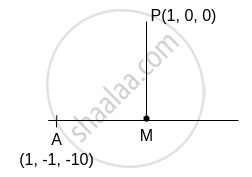
∴ x1 = 1, y1 = −1, z1 = −10

Direction ratios are 2, 3, -8

let L1: `(x - 1)/(2) = (y + 1)/(-3) = (z + 10)/(8)`

∴ Parametrics co-ordinates (2λ + 1, −3λ − 1, 8λ −10)

∴ The direction ratio of PM is (2λ, −3λ − 1, 8λ −10)

∴ PM is ⊥ to the given line` (2λhati(−3λ −1)hatj + (8λ −10)hatk) * (2hati - 3hatj + 8hatk) = 0`

∴ 4λ + 9λ + 3 + 64λ − 80 = 0

∴ 77λ − 77 = 0

∴ λ = 1

∴ Co-ordinates of the foot of the perpendicular are (3, −4, −2)

∴ d = `sqrt((x_2 - x_1)^2 + (y_2 - y_1)^2 + (z_2 - z_1)^2`

= `sqrt((2)^2 - (-4)^2+ (-2)^2`

= `sqrt (4 + 16 + 4)`

= `sqrt24`

∴ d = `2sqrt6` 

shaalaa.com
  Is there an error in this question or solution?
Chapter 6: Line and Plane - Exercise 6.2 [Page 207]

RELATED QUESTIONS

Find the length of the perpendicular (2, –3, 1) to the line `(x + 1)/(2) = (y - 3)/(3) = (z + 1)/(-1)`.


A(1, 0, 4), B(0, -11, 13), C(2, -3, 1) are three points and D is the foot of the perpendicular from A to BC. Find the co-ordinates of D.


If the lines `(x - 1)/2 = (y + 1)/3 = (z - 1)/4 and (x - 3)/1 = (y - k)/2 = z/1` intersect each other, then find k.


Find the vector equation of a plane which is at 42 unit distance from the origin and which is normal to the vector `2hati + hatj - 2hatk`.


Find the coordinates of the foot of the perpendicular drawn from the origin to the plane 2x + 6y – 3z = 63.


Find the vector equation of the plane passing through the point having position vector `hati + hatj + hatk` and perpendicular to the vector `4hati + 5hatj + 6hatk`.


Show that the line `bar"r" = (2hat"j" - 3hat"k") + lambda(hat"i" + 2hat"j" + 3hat"k") and bar"r" = (2hat"i" + 6hat"j" + 3hat"k") + mu(2hat"i" + 3hat"j" + 4hat"k")` are coplanar. Find the equation of the plane determined by them.


Choose correct alternatives:

If the line `x/(3) = y/(4)` = z is perpendicular to the line `(x - 1)/k = (y + 2)/(3) = (z - 3)/(k - 1)`, then the value of k is ______.


Choose correct alternatives :

The lines `x/(1) = y/(2) = z/(3) and (x - 1)/(-2) = (y - 2)/(-4) = (z - 3)/(6)` are


The perpendicular distance of the plane 2x + 3y – z = k from the origin is `sqrt(14)` units, the value of k is ______.


Choose correct alternatives :

The equation of the plane passing through the points (1, −1, 1), (3, 2, 4) and parallel to the Y-axis is ______  


Solve the following :

Find the perpendicular distance of the origin from the plane 6x + 2y + 3z - 7 = 0


The equation of X axis is ______ 


Find the perpendicular distance of origin from the plane 6x − 2y + 3z - 7 = 0


Find the equation of the plane passing through the point (7, 8, 6) and parallel to the plane `bar"r"*(6hat"i" + 8hat"j" + 7hat"k")` = 0


Show that the lines `(x + 1)/(-10) = (y + 3)/(-1) = (z - 4)/(1)` and `(x + 10)/(-1) = (y + 1)/(-3) = (z - 1)/4` intersect each other.also find the coordinates of the point of intersection


If 0 ≤ x < 2π, then the number of real values of x, which satisfy the equation cos x + cos 2x + cos 3x + cos 4x = 0, is ______


The equation of the plane passing through the point (– 1, 2, 1) and perpendicular to the line joining the points (– 3, 1, 2) and (2, 3, 4) is ______.


Equations of planes parallel to the plane x - 2y + 2z + 4 = 0 which are at a distance of one unit from the point (1, 2, 3) are _______.


If line `(2x - 4)/lambda = ("y" - 1)/2 = ("z" - 3)/1` and `(x - 1)/1 = (3"y" - 1)/lambda = ("z" - 2)/1` are perpendicular to each other then λ = ______.


The equation of the plane through the point (2, -1, -3) and parallel to the lines `(x - 1)/3 = (y + 2)/2 = z/(-4)` and `x/2 = (y - 1)/(-3) = (z - 2)/2` is ______


The equation of the plane, which bisects the line joining the points (1, 2, 3) and (3, 4, 5) at right angles is ______ 


The distance of the point (1, 0, 2) from the point of intersection of the line `(x - 2)/3 = (y + 1)/4 = (z - 2)/12` and the plane x - y + z = 16, is ______ 


The equation of the plane passing through the intersection of the planes x + 2y + 3z + 4 = 0 and 4x + 3y + 2z + 1 = 0 and the origin is ______.


Let the line `(x - 2)/3 = (y - 1)/(-5) = (z + 2)/2` lie in the plane x + 3y - αz + β = 0. Then, (α, β) equals ______ 


If the plane x - 3y + 5z = d passes through the point (1, 2, 4), then the lengths of intercepts cut by it on the axes of X, Y, Z are respectively ______ 


The d.r.s of normal to the plane through (1, 0, 0), (0, 1, 0) which makes an angle `pi/4` with plane x + y = 3, are ______.


The equation of the plane passing through the points (1, –2, 1), (2, –1, –3) and (0, 1, 5) is ______.


The equation of the plane passing through a point having position vector`-2hat"i" + 7hat"j" + 5hat"k"` and parallel to the vectors `4hat"i" - hat"j" + 3hat"k"` and `hat"i" + hat"j" + hat"k"` is ______.


If plane x + ay + z = 4 has equal intercepts on axes, then 'a' is equal to ______.


The equation of the 1 plane passing through the points (1, –1, 1), (3, 2, 4) and parallel to Y-axis is ______.


Let Q be the mirror image of the point P(1, 2, 1) with respect to the plane x + 2y + 2z = 16. Let T be a plane passing through the point Q and contains the line `vecr = -hatk + λ(hati + hatj + 2hatk)`, λ ∈ R. Then, which of the following points lies on T?


Let P be a plane passing through the points (1, 0, 1), (1, –2, 1) and (0, 1, –2). Let a vector `vec"a" = αhat"i" + βhat"j" + γhat"k"` be such that `veca` is parallel to the plane P, perpendicular to `(hat"i"+2hat"j"+3hat"k")`and `vec"a".(hat"i" + hat"j" + 2hat"j")` = 2, then (α – β + γ)2 equals ______.


The equation of the plane through the line x + y + z + 3 = 0 = 2x – y + 3z + 1 and parallel to the line `x/1 = y/2 = z/3`, is ______.


If A and B are foot of perpendicular drawn from point Q(a, b, c) to the planes yz and zx, then equation of plane through the points A, B and O is ______.


If the foot of the perpendicular drawn from the origin to the plane is (4, –2, 5), then the equation of the plane is ______.


Find the equation of the plane containing the lines `(x - 1)/2 = (y + 1)/-1 = z/3` and `x/2 = (y - 2)/-1 = (z + 1)/3`.


Reduce the equation `barr*(3hati - 4hatj + 12hatk)` = 3 to the normal form and hence find the length of perpendicular from the origin to the plane.


Find the equation of plane which is at a distance of 4 units from the origin and which is normal to the vector `2hati - 2hatj + hatk`.


Find the equation of the plane which contains the line of intersection of the planes x + 2y + 4z = 4 and 2x – 3y – z = 9 and which is perpendicular to the plane 4x – 3y + 5z = 10.


Share
Notifications

Englishहिंदीमराठी


      Forgot password?
Use app×