Advertisements
Advertisements
प्रश्न
Find the perpendicular distance of the point (1, 0, 0) from the line `(x - 1)/(2) = (y + 1)/(-3) = (z + 10)/(8)` Also find the co-ordinates of the foot of the perpendicular.
Advertisements
उत्तर
Let foot of the perpendicular 'M' is drawn from point p(1, 0, 0) the line L: `(x - 1)/(2) = (y + 1)/(-3) = (z + 10)/(8)`
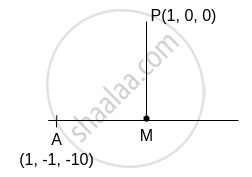
∴ x1 = 1, y1 = −1, z1 = −10
Direction ratios are 2, 3, -8
let L1: `(x - 1)/(2) = (y + 1)/(-3) = (z + 10)/(8)`
∴ Parametrics co-ordinates (2λ + 1, −3λ − 1, 8λ −10)
∴ The direction ratio of PM is (2λ, −3λ − 1, 8λ −10)
∴ PM is ⊥ to the given line` (2λhati(−3λ −1)hatj + (8λ −10)hatk) * (2hati - 3hatj + 8hatk) = 0`
∴ 4λ + 9λ + 3 + 64λ − 80 = 0
∴ 77λ − 77 = 0
∴ λ = 1
∴ Co-ordinates of the foot of the perpendicular are (3, −4, −2)
∴ d = `sqrt((x_2 - x_1)^2 + (y_2 - y_1)^2 + (z_2 - z_1)^2`
= `sqrt((2)^2 - (-4)^2+ (-2)^2`
= `sqrt (4 + 16 + 4)`
= `sqrt24`
∴ d = `2sqrt6`
APPEARS IN
संबंधित प्रश्न
Find the co-ordinates of the foot of the perpendicular drawn from the point `2hati - hatj + 5hatk` to the line `barr = (11hati - 2hatj - 8hatk) + λ(10hati - 4hatj - 11hatk).` Also find the length of the perpendicular.
Find the coordinates of the foot of the perpendicular drawn from the origin to the plane 2x + 6y – 3z = 63.
Find the vector equation of the plane passing through the point having position vector `hati + hatj + hatk` and perpendicular to the vector `4hati + 5hatj + 6hatk`.
Show that the line `bar"r" = (2hat"j" - 3hat"k") + lambda(hat"i" + 2hat"j" + 3hat"k") and bar"r" = (2hat"i" + 6hat"j" + 3hat"k") + mu(2hat"i" + 3hat"j" + 4hat"k")` are coplanar. Find the equation of the plane determined by them.
Choose correct alternatives :
The lines `x/(1) = y/(2) = z/(3) and (x - 1)/(-2) = (y - 2)/(-4) = (z - 3)/(6)` are
Choose correct alternatives :
Equation of X-axis is ______.
Choose correct alternatives :
The equation of the plane passing through (2, -1, 3) and making equal intercepts on the coordinate axes is
Choose correct alternatives :
The direction cosines of the normal to the plane 2x – y + 2z = 3 are ______
Choose correct alternatives :
The equation of the plane in which the line `(x - 5)/(4) = (y - 7)/(4) = (z + 3)/(-5) and (x - 8)/(7) = (y - 4)/(1) = (z - 5)/(3)` lie, is
Choose correct alternatives :
The foot of perpendicular drawn from the point (0,0,0) to the plane is (4, -2, -5) then the equation of the plane is
Solve the following :
Find the perpendicular distance of the origin from the plane 6x + 2y + 3z - 7 = 0
Solve the following :
Find the coordinates of the foot of the perpendicular drawn from the origin to the plane 2x + 3y + 6z = 49.
The equation of X axis is ______
If the foot of the perpendicular drawn from the origin to the plane is (4, −2, -5), then the equation of the plane is ______
The coordinates of the foot of perpendicular drawn from the origin to the plane 2x + y − 2z = 18 are ______
Find direction cosines of the normal to the plane `bar"r"*(3hat"i" + 4hat"k")` = 5
Find the perpendicular distance of origin from the plane 6x − 2y + 3z - 7 = 0
Show that the lines `(x + 1)/(-10) = (y + 3)/(-1) = (z - 4)/(1)` and `(x + 10)/(-1) = (y + 1)/(-3) = (z - 1)/4` intersect each other.also find the coordinates of the point of intersection
The equation of the plane passing through the point (– 1, 2, 1) and perpendicular to the line joining the points (– 3, 1, 2) and (2, 3, 4) is ______.
The intercepts of the plane 3x - 4y + 6z = 48 on the co-ordinate axes are ______
Equations of planes parallel to the plane x - 2y + 2z + 4 = 0 which are at a distance of one unit from the point (1, 2, 3) are _______.
Equation of plane parallel to ZX-plane and passing through the point (0, 5, 0) is ______
XY-plane divides the line joining the points A(2, 3, -5) and B(1, -2, -3) in the ratio ______
The distance of the point (1, 0, 2) from the point of intersection of the line `(x - 2)/3 = (y + 1)/4 = (z - 2)/12` and the plane x - y + z = 16, is ______
If the plane passing through the points (1, 2, 3), (2, 3, 1) and (3, 1, 2) is ax + by + cz = d then a + 2b + 3c = ______.
If plane x + ay + z = 4 has equal intercepts on axes, then 'a' is equal to ______.
If the line `(x + 1)/2 = (y - 5)/3 = (z - "p")/6` lies in the plane 3x – 14y + 6z + 49 = 0, then the value of p is ______.
Let Q be the mirror image of the point P(1, 2, 1) with respect to the plane x + 2y + 2z = 16. Let T be a plane passing through the point Q and contains the line `vecr = -hatk + λ(hati + hatj + 2hatk)`, λ ∈ R. Then, which of the following points lies on T?
Find the equation of the plane containing the lines `(x - 1)/2 = (y + 1)/-1 = z/3` and `x/2 = (y - 2)/-1 = (z + 1)/3`.
Reduce the equation `barr*(3hati - 4hatj + 12hatk)` = 3 to the normal form and hence find the length of perpendicular from the origin to the plane.
Find the equation of plane which is at a distance of 4 units from the origin and which is normal to the vector `2hati - 2hatj + hatk`.
Find the point of intersection of the line `(x + 1)/2 = (y - 1)/3 = (z - 2)/1` with the plane x + 2y – z = 6.
A mobile tower is situated at the top of a hill. Consider the surface on which the tower stands as a plane having points A(1, 0, 2), B(3, –1, 1) and C(1, 2, 1) on it. The mobile tower is tied with three cables from the points A, B and C such that it stands vertically on the ground. The top of the tower is at point P(2, 3, 1) as shown in the figure below. The foot of the perpendicular from the point P on the plane is at the point `Q(43/29, 77/29, 9/29)`.

Answer the following questions.
- Find the equation of the plane containing the points A, B and C.
- Find the equation of the line PQ.
- Calculate the height of the tower.
