Advertisements
Advertisements
Question
Find the number of sides in a regular polygon, if its interior angle is equal to its exterior angle.
Advertisements
Solution
Let each exterior angle or interior angle be = x°
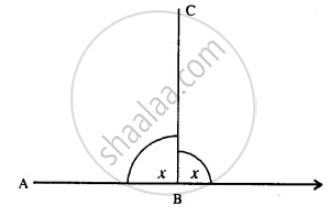
∴ x + x = 180°
2x = 180°
x = 90°
Now, let no. of sides = n
∵ each exterior angle = `360^circ/"n"`
∴ 90° = `360^circ/"n"`
n = `360^circ/90^circ`
n = 4
APPEARS IN
RELATED QUESTIONS
Find the number of sides in a regular polygon, if its interior angle is: 160°
Find the number of sides in a regular polygon, if its exterior angle is : `1/3` of right angle
Is it possible to have a regular polygon whose each exterior angle is: 40° of a right angle.
The measure of each interior angle of a regular polygon is five times the measure of its exterior angle. Find :
(i) measure of each interior angle ;
(ii) measure of each exterior angle and
(iii) number of sides in the polygon.
AB, BC and CD are three consecutive sides of a regular polygon. If angle BAC = 20° ; find :
(i) its each interior angle,
(ii) its each exterior angle
(iii) the number of sides in the polygon.
If the difference between the exterior angle of a 'n' sided regular polygon and an (n + 1) sided regular polygon is 12°, find the value of n.
The ratio between the number of sides of two regular polygons is 3 : 4 and the ratio between the sum of their interior angles is 2 : 3. Find the number of sides in each polygon.
Find the number of sides in a regular polygon, if its interior angle is: 150°
Is it possible to have a regular polygon whose interior angle is: 155°
What is the sum of all exterior angles of any regular polygon?
