Advertisements
Advertisements
Question
Find the equation of circle (a) passing through the origin and having intercepts 4 and −5 on the co-ordinate axes
Advertisements
Solution
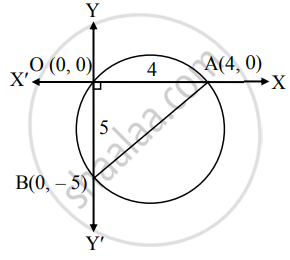
Since the circle passes through the origin and having intercepts 4 and – 5 on the coordinate axes, the circle cuts the X-axis at A(4, 0) and Y-axis at B(0, – 5).
∴ ∠AOB is a right angle.
∴ seg AB is a diameter of the circle.
∴ by diameter form, the equation of the circle is
(x – 4)(x – 0) + (y – 0)(y + 5) = 0
∴ x2 – 4x + y2 + 5y = 0
∴ x2 + y2 – 4x + 5y = 0.
APPEARS IN
RELATED QUESTIONS
Find the equation of the circle with centre at origin and radius 4.
Find the equation of the circle with centre at (−3, −2) and radius 6.
Find the equation of the circle with centre at (2, −3) and radius 5.
Find the equation of the circle with centre at (−3, −3) passing through the point (−3, −6)
Find the centre and radius of the circle:
x2 + y2 = 25
Find the equation of the circle with centre at (a, b) touching the Y-axis
Find the equation of the circle with centre at (–2, 3) touching the X-axis.
Find the equation of the circle with centre on the X-axis and passing through the origin having radius 4.
Find the equation of the circle with centre at (3,1) and touching the line 8x − 15y + 25 = 0
If y = 2x is a chord of circle x2 + y2−10x = 0, find the equation of circle with this chord as diametre
Find the centre and radius of the following:
x2 + y2 − 2x + 4y − 4 = 0
Find the centre and radius of the following:
4x2 + 4y2 − 24x − 8y − 24 = 0
Show that the equation 3x2 + 3y2 + 12x + 18y − 11 = 0 represents a circle
Find the equation of the circle passing through the points (5, 7), (6, 6) and (2, −2)
Show that the points (3, −2), (1, 0), (−1, −2) and (1, −4) are concyclic
Choose the correct alternative:
If the lines 2x − 3y = 5 and 3x − 4y = 7 are the diameters of a circle of area 154 sq. units, then find the equation of the circle
Choose the correct alternative:
Find the equation of the circle which passes through the points (2, 3) and (4, 5) and the centre lies on the straight line y − 4x + 3 = 0
Choose the correct alternative:
Area of the circle centre at (1, 2) and passing through (4, 6) is
Choose the correct alternative:
If a circle passes through the point (0, 0), (a, 0) and (0, b) then find the co-ordinates of its centre
Choose the correct alternative:
The equation of a circle with origin as centre and passing through the vertices of an equilateral triangle whose median is of length 3a is
Answer the following :
Find the centre and radius of the circle x2 + y2 − x +2y − 3 = 0
Answer the following :
Find the centre and radius of the circle x = 3 – 4 sinθ, y = 2 – 4cosθ
Answer the following :
Show that the circles touch each other internally. Find their point of contact and the equation of their common tangent:
x2 + y2 + 4x – 12y + 4 = 0,
x2 + y2 – 2x – 4y + 4 = 0
Answer the following :
Find the length of the tangent segment drawn from the point (5, 3) to the circle x2 + y2 + 10x – 6y – 17 = 0
If 2x - 4y = 9 and 6x - 12y + 7 = 0 are the tangents of same circle, then its radius will be ______
The centre of the circle x = 3 + 5 cos θ, y = - 4 + 5 sin θ, is ______
If the radius of a circle increases from 3 cm to 3.2 cm, then the increase in the area of the circle is ______
The radius of a circle is increasing uniformly at the rate of 2.5cm/sec. The rate of increase in the area when the radius is 12cm, will be ______
If x2 + (2h - 1)xy + y2 - 24x - 8y + k = 0 is the equation of the circle and 12 is the radius of the circle, then ______.
The equation of a circle with centre at (1, 0) and circumference 10π units is ______.
