Advertisements
Advertisements
Question
Find the distance of the point (2, 3, 4) measured along the line `(x - 4)/3 = (y + 5)/6 = (z + 1)/2` from the plane 3x + 2y + 2z + 5 = 0.
Advertisements
Solution
Here, Equation of line PQ is `(x - 2)/3 = (y - 3)/6 = (z - 4)/2` = λ(let)
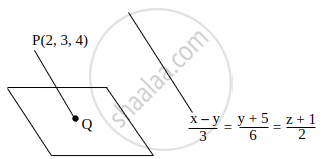
∴ Q(3λ + 2, 6λ + 3, 2λ + 4)
Point Q lies on the plane 3x + 2y + 2z + 5 = 0
∴ 3(3λ + 2) + 2(6λ + 3) + 2(2λ + 4) + 5 = 0
⇒ 9λ + 6 + 12λ + 6 + 4λ + 8 + 5 = 0
⇒ 25λ = –25
⇒ λ = –1
So, Q(–1, –3, 2)
Now, distance between points P(2, 3, 4) and Q(–1, –3, 2) is given by
d = `sqrt((1 - 1 - 2)^2 + (-3 - 3)^2 + (2 - 4)^2)`
= `sqrt(9 + 36 + 4)`
= `sqrt(49)`
= 7 units
APPEARS IN
RELATED QUESTIONS
Find the equation of the planes parallel to the plane x + 2y+ 2z + 8 =0 which are at the distance of 2 units from the point (1,1, 2)
In the given cases, find the distance of each of the given points from the corresponding given plane
Point Plane
(3, – 2, 1) 2x – y + 2z + 3 = 0
In the given cases, find the distance of each of the given points from the corresponding given plane.
Point Plane
(– 6, 0, 0) 2x – 3y + 6z – 2 = 0
Find the distance of the point (−1, −5, −10) from the point of intersection of the line `vecr = 2hati -hatj + 2hatk + lambda(3hati + 4hatj + 2hatk)` and the plane `vecr.(hati -hatj + hatk) = 5`.
Distance between the two planes: 2x + 3y + 4z = 4 and 4x + 6y + 8z = 12 is
(A) 2 units
(B) 4 units
(C) 8 units
(D)`2/sqrt29 "units"`
Show that the points (1, –1, 3) and (3, 4, 3) are equidistant from the plane 5x + 2y – 7z + 8 = 0
Find the distance of the point (1, 2, –1) from the plane x - 2y + 4z - 10 = 0 .
Find the distance of the point \[2 \hat{i} - \hat{j} - 4 \hat{k}\] from the plane \[\vec{r} \cdot \left( 3 \hat{i} - 4 \hat{j} + 12 \hat{k} \right) - 9 = 0 .\]
Show that the points \[\hat{i} - \hat{j} + 3 \hat{k} \text{ and } 3 \hat{i} + 3 \hat{j} + 3 \hat{k} \] are equidistant from the plane \[\vec{r} \cdot \left( 5 \hat{i} + 2 \hat{j} - 7 \hat{k} \right) + 9 = 0 .\]
Find the distance of the point (2, 3, −5) from the plane x + 2y − 2z − 9 = 0.
Find the equations of the planes parallel to the plane x + 2y − 2z + 8 = 0 that are at a distance of 2 units from the point (2, 1, 1).
Show that the points (1, 1, 1) and (−3, 0, 1) are equidistant from the plane 3x + 4y − 12z + 13 = 0.
Find the equations of the planes parallel to the plane x − 2y + 2z − 3 = 0 and which are at a unit distance from the point (1, 1, 1).
Find the distance of the point (3, 3, 3) from the plane \[\vec{r} \cdot \left( 5 \hat{i} + 2 \hat{j} - 7k \right) + 9 = 0\]
Find the distance of the point (1, −2, 3) from the plane x − y + z = 5 measured parallel to the line whose direction cosines are proportional to 2, 3, −6.
If the product of the distances of the point (1, 1, 1) from the origin and the plane x − y + z+ λ = 0 be 5, find the value of λ.
Find an equation for the set of all points that are equidistant from the planes 3x − 4y + 12z = 6 and 4x + 3z = 7.
Find the distance between the point (7, 2, 4) and the plane determined by the points A(2, 5, −3), B(−2, −3, 5) and C (5, 3, −3).
Find the distance between the parallel planes 2x − y + 3z − 4 = 0 and 6x − 3y + 9z + 13 = 0.
Find the equation of the plane which passes through the point (3, 4, −1) and is parallel to the plane 2x − 3y + 5z + 7 = 0. Also, find the distance between the two planes.
Find the distance between the planes \[\vec{r} \cdot \left( \hat{i} + 2 \hat{j} + 3 \hat{k} \right) + 7 = 0 \text{ and } \vec{r} \cdot \left( 2 \hat{i} + 4 \hat{j} + 6 \hat{k} \right) + 7 = 0 .\]
The image of the point (1, 3, 4) in the plane 2x − y + z + 3 = 0 is
If a plane passes through the point (1, 1, 1) and is perpendicular to the line \[\frac{x - 1}{3} = \frac{y - 1}{0} = \frac{z - 1}{4}\] then its perpendicular distance from the origin is ______.
Write the coordinates of the point which is the reflection of the point (α, β, γ) in the XZ-plane.
Find the distance of the point `4hat"i" - 3hat"j" + hat"k"` from the plane `bar"r".(2hat"i" + 3hat"j" - 6hat"k")` = 21.
Find the distance of the point (1, 1 –1) from the plane 3x +4y – 12z + 20 = 0.
Solve the following :
Find the distance of the point (13, 13, – 13) from the plane 3x + 4y – 12z = 0.
The equation of the plane passing through (3, 1, 2) and making equal intercepts on the coordinate axes is _______.
The equations of planes parallel to the plane x + 2y + 2z + 8 = 0, which are at a distance of 2 units from the point (1, 1, 2) are ________.
Find the distance of the point whose position vector is `(2hat"i" + hat"j" - hat"k")` from the plane `vec"r" * (hat"i" - 2hat"j" + 4hat"k")` = 9
Find the distance of the point (– 2, 4, – 5) from the line `(x + 3)/3 = (y - 4)/5 = (z + 8)/6`
A plane meets the co-ordinates axis in A, B, C such that the centroid of the ∆ABC is the point (α, β, γ). Show that the equation of the plane is `x/alpha + y/beta + z/ϒ` = 3
The distance of a point P(a, b, c) from x-axis is ______.
The distance of the plane `vec"r" *(2/7hat"i" + 3/4hat"j" - 6/7hat"k")` = 1 from the origin is ______.
Find the foot of the perpendicular from the point (1, 2, 0) upon the plane x – 3y + 2z = 9. Hence, find the distance of the point (1, 2, 0) from the given plane.
Which one of the following statements is correct for a moving body?
The fuel charges for running a train are proportional to the square of the speed generated in miles per hour and costs ₹ 48 per hour at 16 miles per hour. The most economical speed if the fixed charges i.e. salaries etc. amount to ₹ 300 per hour is
`phi` is the angle of the incline when a block of mass m just starts slipping down. The distance covered by the block if thrown up the incline with an initial speed u0 is
The coordinates of the point on the parabola y2 = 8x which is at minimum distance from the circle x2 + (y + 6)2 = 1 are
If the distance of the point (1, 1, 1) from the plane x – y + z + λ = 0 is `5/sqrt(3)`, find the value(s) of λ.
Find the distance of the point (1, –2, 0) from the point of the line `vecr = 4hati + 2hatj + 7hatk + λ(3hati + 4hatj + 2hatk)` and the point `vecr.(hati - hatj + hatk)` = 10.
The acute angle between the line `vecr = (hati + 2hatj + hatk) + λ(hati + hatj + hatk)` and the plane `vecr xx (2hati - hatj + hatk)` is ______.
If the points (1, 1, λ) and (–3, 0, 1) are equidistant from the plane `barr*(3hati + 4hatj - 12hatk) + 13` = 0, find the value of λ.
In the figure given below, if the coordinates of the point P are (a, b, c), then what are the perpendicular distances of P from XY, YZ and ZX planes respectively?

