Advertisements
Advertisements
प्रश्न
Find the distance of the point (2, 3, 4) measured along the line `(x - 4)/3 = (y + 5)/6 = (z + 1)/2` from the plane 3x + 2y + 2z + 5 = 0.
Advertisements
उत्तर
Here, Equation of line PQ is `(x - 2)/3 = (y - 3)/6 = (z - 4)/2` = λ(let)
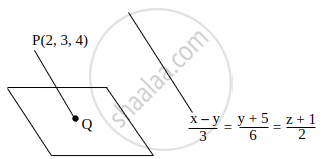
∴ Q(3λ + 2, 6λ + 3, 2λ + 4)
Point Q lies on the plane 3x + 2y + 2z + 5 = 0
∴ 3(3λ + 2) + 2(6λ + 3) + 2(2λ + 4) + 5 = 0
⇒ 9λ + 6 + 12λ + 6 + 4λ + 8 + 5 = 0
⇒ 25λ = –25
⇒ λ = –1
So, Q(–1, –3, 2)
Now, distance between points P(2, 3, 4) and Q(–1, –3, 2) is given by
d = `sqrt((1 - 1 - 2)^2 + (-3 - 3)^2 + (2 - 4)^2)`
= `sqrt(9 + 36 + 4)`
= `sqrt(49)`
= 7 units
APPEARS IN
संबंधित प्रश्न
Show that the points (1, 1, 1) and (-3, 0, 1) are equidistant from the plane `bar r (3bari+4barj-12bark)+13=0`
In the given cases, find the distance of each of the given points from the corresponding given plane.
Point Plane
(0, 0, 0) 3x – 4y + 12 z = 3
In the given cases, find the distance of each of the given points from the corresponding given plane.
Point Plane
(2, 3, – 5) x + 2y – 2z = 9
Show that the points \[\hat{i} - \hat{j} + 3 \hat{k} \text{ and } 3 \hat{i} + 3 \hat{j} + 3 \hat{k} \] are equidistant from the plane \[\vec{r} \cdot \left( 5 \hat{i} + 2 \hat{j} - 7 \hat{k} \right) + 9 = 0 .\]
Find the equations of the planes parallel to the plane x + 2y − 2z + 8 = 0 that are at a distance of 2 units from the point (2, 1, 1).
Find the equations of the planes parallel to the plane x − 2y + 2z − 3 = 0 and which are at a unit distance from the point (1, 1, 1).
Find an equation for the set of all points that are equidistant from the planes 3x − 4y + 12z = 6 and 4x + 3z = 7.
Find the distance of the point (1, -2, 4) from plane passing throuhg the point (1, 2, 2) and perpendicular of the planes x - y + 2z = 3 and 2x - 2y + z + 12 = 0
Find the equation of the plane which passes through the point (3, 4, −1) and is parallel to the plane 2x − 3y + 5z + 7 = 0. Also, find the distance between the two planes.
Find the distance between the planes \[\vec{r} \cdot \left( \hat{i} + 2 \hat{j} + 3 \hat{k} \right) + 7 = 0 \text{ and } \vec{r} \cdot \left( 2 \hat{i} + 4 \hat{j} + 6 \hat{k} \right) + 7 = 0 .\]
The distance between the planes 2x + 2y − z + 2 = 0 and 4x + 4y − 2z + 5 = 0 is
The distance of the line \[\vec{r} = 2 \hat{i} - 2 \hat{j} + 3 \hat{k} + \lambda\left( \hat{i} - \hat{j}+ 4 \hat{k} \right)\] from the plane \[\vec{r} \cdot \left( \hat{i} + 5 \hat{j} + \hat{k} \right) = 5\] is
If a plane passes through the point (1, 1, 1) and is perpendicular to the line \[\frac{x - 1}{3} = \frac{y - 1}{0} = \frac{z - 1}{4}\] then its perpendicular distance from the origin is ______.
Write the coordinates of the point which is the reflection of the point (α, β, γ) in the XZ-plane.
Find the distance of the point (1, 1 –1) from the plane 3x +4y – 12z + 20 = 0.
The equation of the plane passing through (3, 1, 2) and making equal intercepts on the coordinate axes is _______.
Find the distance of the point (– 2, 4, – 5) from the line `(x + 3)/3 = (y - 4)/5 = (z + 8)/6`
The distance of a point P(a, b, c) from x-axis is ______.
Find the distance of a point (2, 4, –1) from the line `(x + 5)/1 = (y + 3)/4 = (z - 6)/(-9)`
Distance of the point (α, β, γ) from y-axis is ____________.
Which one of the following statements is correct for a moving body?
`phi` is the angle of the incline when a block of mass m just starts slipping down. The distance covered by the block if thrown up the incline with an initial speed u0 is
If the points (1, 1, λ) and (–3, 0, 1) are equidistant from the plane `barr*(3hati + 4hatj - 12hatk) + 13` = 0, find the value of λ.
A plane passes through (1,-2,1) and is perpendicular to the planes 2x - 2y + z = 0 and x - y + 2z = 4. The distance of the point (1, 2, 2) from this plane is______ units.
