Advertisements
Advertisements
Question
Find the area of a triangle, whose sides are :
10 cm, 24 cm, and 26 cm
Advertisements
Solution
Sides of ∆ are
a = 10 cm
b = 24 cm
c = 26 cm
S = `(a + b + c)/2 = (10 + 24 + 26)/2`
= `60/2 = 30`
area of Δ = `sqrt(S(S - a)(S - b)(S - c))`
= `sqrt(30(30 - 10)(30 - 24)(30 - 26))`
= `sqrt(30 xx 20 xx 6 xx 4)`
= `sqrt(10 xx 3 xx 10 xx 2 xx 2 xx 3 xx 2 xx 2)`
= `sqrt(10 xx 10 xx 3 xx 3 xx 2 xx 2 xx 2 xx 2)`
= `10 xx 3 xx 2 xx 2 = 120 "cm"^2`
APPEARS IN
RELATED QUESTIONS
If the difference between the sides of a right-angled triangle is 3 cm and its area is 54 cm2; find its perimeter.
Calculate the area and the height of an equilateral triangle whose perimeter is 60 cm.
Two sides of a triangle are 6.4 m and 4.8 m. If the height of the triangle corresponding to 4.8 m side is 6 m;
find :
(i) area of the triangle ;
(ii) height of the triangle corresponding to 6.4 m sides.
A field is in the shape of a quadrilateral ABCD in which side AB = 18 m, side AD = 24 m, side BC = 40m, DC = 50 m and angle A = 90°. Find the area of the field.
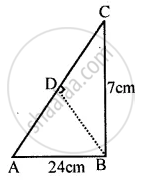
Use the information given in the adjoining figure to find :
(i) the length of AC.
(ii) the area of an ∆ABC
(iii) the length of BD, correct to one decimal place.
The table given below contains some measures of the triangle. Find the unknown values.
| Side 1 | Side 2 | Side 3 | Perimeter |
| ? | 8 m | 3 m | 17 m |
A piece of wire is 36 cm long. What will be the length of each side if we form an equilateral triangle
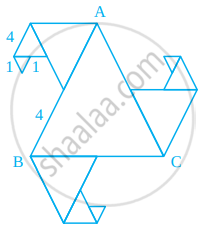
In the following figure, all triangles are equilateral and AB = 8 units. Other triangles have been formed by taking the mid points of the sides. What is the perimeter of the figure?
A piece of string is 30 cm long. What will be the length of each side if the string is used to form an equilateral triangle?
Area of an isosceles triangle is 48 cm2. If the altitudes corresponding to the base of the triangle is 8 cm, find the perimeter of the triangle.
